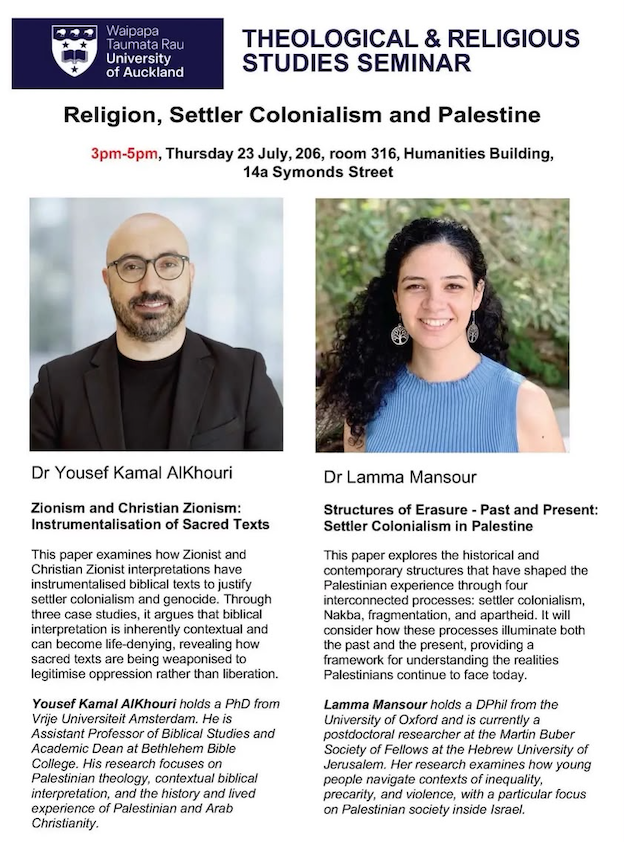

by Sheree Trotter
Part One
Two Palestinian academics, Dr Lamma Mansour and Dr Yousef Kamal AlKhoury are currently touring New Zealand for a series of talks, held mostly in Anglican churches, but also in at least one university. They have been presenting one-sided, heavily truncated accounts of the complex Israel-Palestinian conflict. While we acknowledge their right to tell their story, we believe the lack of context and historical depth presents a false, distorted and harmful picture. This is the first in a series of articles that will address these concerns.
The Palestinian Narrative: Centering the Nakba
Dr Mansour argues that the Nakba is the central point of all Palestinian history and is an ongoing process that continues until this day. Nakba means catastrophe and it is the word, she claims, that is used to describe the ‘mass displacement and dispossession of Palestinians in 1948’, when ‘Zionist militias violently expelled over 750,000 Palestinians from their homes’.
The Nakba is a powerful formation story for the Palestinians. The notion of Palestinian dispossession as a defining historical event was inscribed by the Palestinian intellectual Edward Said in his 1994 work, ‘The Politics of Dispossession’. This became one of the foundational texts for later scholarship in post-colonial studies and Palestine studies. Said, known as the father of post-colonialism, played a major role in shaping and internationalizing the discourse of ‘victimhood’ as a Palestinian political identity built around dispossession.
It has become a popular and compelling narrative, repeated frequently in universities, churches and international institutions. However, the political framing of this event has led to a one-sided, incomplete and decontextualized curation of history. A number of salient facts are missing from the Palestinian narrative.
The historical connection of the Jewish people to Palestine and the grounds for reconstituting a Jewish national home was formally recognised by the international community in the 1920 San Remo Resolution and the 1922 League of Nations Mandate for Palestine.
In 1947, the UN, in seeking to resolve the conflict between Arabs and Jews under the British Mandate for Palestine, offered a two-state solution, which the Arabs rejected and the Jews accepted.
May 1948 saw the Jewish authorities declare statehood. The fledgling state was immediately attacked by five regular Arab armies — Egypt, Transjordan (Jordan), Syria, Iraq, and Lebanon — supported by irregular Arab forces and smaller contingents from other Arab states, seeking to ‘drive the Jews into the sea’.
The Jewish people had experienced a genocide in Europe, in which six million were murdered and faced the refusal of the rest of the world to receive refugees. This was (another) existential struggle.
The Arab exodus occurred during an Arab-initiated war and resulted from a combination of factors: flight from active fighting, expulsions in some locations, fear generated by the conflict, collapse of local leadership and, in many instances, encouragement by Arab military or political leaders to leave temporarily until the new Jewish state was destroyed. Many of those Arabs who chose to stay are today Arab Israeli citizens with full rights.
Between 1948 and the early 1970s, roughly 850,000 Jews left or were expelled from Arab countries, a demographic upheaval comparable in scale to the Palestinian refugee crisis but rarely incorporated into discussions of 1948. These refugees were resettled in the new Jewish state.
Mansour, in her online presentations, makes much of the plight of Palestinian refugees, relating that some of them carry the keys to the homes they lived in prior to 1948. But she fails to mention that Palestinians are the only people in the world who have an UN organisation dedicated solely to them, UNRWA, while the rest of the world is represented by UNHCR (Office of the High Commissioner for Refugees). UNRWA is the only UN agency that passes ‘refugee’ status down through descendants indefinitely, which is why the Palestinian refugee count grew from 700,000 in 1948 to over 5 million today. Further, UNRWA has a deeply problematic record, promoting antisemitic school curricula. Indeed, amongst UNRWA staff were Hamas members who participated in the attack on 7 October.
What is framing and driving this selective narrative: Settler Colonial theory?
The Palestinian narrative is deeply influenced by post-colonial ideologies, in particular settler colonial theory (SCT). It is evident in these kinds of statements - “Nakbah is a process that continues until today”. This builds on Patrick Wolfe's formulation that, “Settler colonizers come to stay: invasion is a structure not an event…Settler colonialism destroys to replace.” (Patrick Wolfe, Settler Colonialism and the Elimination of the Native, 2006)
By this he means thatsettler colonialism is an enduring social, political, and legal system rather than a single historical conquest and settler projects seek to replace Indigenous political and social orders with a new settler society.
A central interpretive device of SCT, related to critical race theory, is that of power relationships. The world is divided into a binary - fixed categories of oppressor and oppressed. In this worldview, victims are inherently righteous, because they supposedly lack power and therefore lack agency, the ability to make choices. It follows that the oppressor has determinative power and is inherently evil. Under this framework, history becomes morally predetermined. Agency flows almost entirely to the coloniser. The colonised are acted upon rather than acting. Their choices become reactions rather than decisions.
Palestinians are portrayed as the Indigenous people of the land who have been dispossessed by foreign European colonizers. This, despite the reality that Jews have had a continuous presence in the land for over 3,000 years. It is the land within which their unique peoplehood and culture developed. This is affirmed by archaeological evidence, genetic studies, and unbroken textual and liturgical reference to the land.
The Gaps in the Settler Colonial Narrative
In order to pursue its blanket oppressor/oppressed narrative, SC theory has to ignore much historical and political context.
Claiming Indigeneity of course assists the Palestinian claim for victimhood status. However, Palestinian leaders could have made beneficial choices for their people, such as accepting one of the many offers of ‘land for peace’. Palestinian leaders could have chosen to cease teaching their children that all of the land is for Arabs and not Jews. They could have built a state in the territory they control, rather than manipulating international fora to condemn Israel. SC theorists will not tell their audience that many Palestinians view the Palestinian Authority (PA) as corrupt, ineffective, authoritarian and unable to achieve statehood, that there hasn’t been a presidential election since 2005, and parliamentary election since 2006 or that they have a ‘slay to pay’ policy which incentivises acts of terror.
Rather, the narrative insists that the Nakba is a process that continues until today with ‘illegal settlements’ in the ‘West Bank’, Palestinians forced from homes and many other such claims. This ignores the history of attempts to work towards a peaceful solution. The Oslo Accords were envisaged as the beginning of a new relationship in which Israel would recognise the PLO as the representative of the Palestinian people and agree to a staged withdrawal from certain territories. It was expected the Palestinians would reciprocate by recognising Israel’s right to exist, renouncing terrorism, and committing to resolve all outstanding disputes through direct negotiations.
Since the 1993 Oslo Accords, Israel has made multiple major land-for-peace proposals that would have established a Palestinian state in most of the West Bank and Gaza, with East Jerusalem as its capital in some form. These included the Camp David Summit (2000), the more expansive Taba negotiations (2001), and Prime Minister Ehud Olmert’s 2008 proposal, each involving Israeli territorial withdrawals and land swaps. None resulted in a final agreement, due to disagreements over borders, Jerusalem, refugees, security, and mutual recognition.
The Palestinian narrative ignores the decisions made by Palestinian leaders. They spurned the opportunity to develop Palestinian self-governance, and to negotiate for the so-called “final status” issues — borders, refugees, Jerusalem, settlements, and security. This required being willing to live peacefully alongside Israel. They chose instead Intifada — a five-year campaign of suicide bombings, shootings, and rocket fire that killed over 1,000 Israelis and many more Palestinians.
The claim of “Israeli occupation” sits uneasily with the fact that Israel completely withdrew from Gaza in 2005, offering the Palestinians the opportunity for self-governance. It led to a violent take-over by Hamas in 2007 who, in order to fulfil its genocidal goal to eliminate Israel, invested in terror tunnels and rockets instead of building a state.
The Apartheid claim
Mansour's own academic career illustrates the complexity of Israeli society. Born in Nazareth, she completed degrees at the University of Haifa, studied at Oxford, and is now a research fellow at the Hebrew University of Jerusalem. Those facts are deeply dissonant with her claim that Israel operates a system analogous to apartheid South Africa.
The reality is that Israel does not meet the legal definition of apartheid. Arab citizens possess full political rights. There are Arabs in all segments of Israeli society from doctors to lawyers, politicians to judges. None of this was possible under South Africa’s apartheid regime.
Mansour employs the idea of ‘fragmentation’ which consists of observing that Palestinians live in separate zones; Gaza, East Jerusalem, West Bank, Diaspora refugees, Palestinian citizens of Israel. She offers no reason why this might be so. Conspicuously absent were arrangements agreed to by Palestinians in the Oslo Accords, or multiple major land-for-peace proposals to establish a Palestinian state in most of the West Bank and Gaza, with East Jerusalem as its capital, in some form. The differing legal regimes in the Judea and Samaria stem from an unresolved armed conflict rather than racial ideology, and Israeli governments have repeatedly negotiated for a two-state solution rather than seeking permanent domination over another racial group.
Also ignored were decisions made by Palestinian leaders who spurned the opportunity to develop Palestinian self-governance and negotiate the so-called ‘final status’ issues — borders, refugees, Jerusalem, settlements, and security. This required a willingness to live peacefully alongside Israel. They chose instead Intifada — a five-year campaign of suicide bombings, shootings, and rocket fire that killed over 1,000 Israelis and many more Palestinians. One of the Israeli responses to Intifada II was the construction of a security wall and increased restrictions at security checkpoints.
The unilateral Israeli withdrawal from Gaza in 2005 was ignored, as was the fact that Hamas violently took control in 2007, and, in order to fulfil its genocidal goal to eliminate Israel, prioritized terror tunnels and rockets.
The Genocide Libel
Of course, the list of libels in the current antizionist zeitgeist would not be complete without the accusation of genocide. Neither presenter engaged with the legal definition of genocide, which according to the United Nations Genocide Convention (1948) consists of prohibited acts committed with specific intent to destroy, in whole or in part, a national, ethnic, racial, or religious group. Rather, Mansour performed a maneuvour of re-defining genocide as the ‘brutal culmination of all four processes: settler-colonialism, Nakba, fragmentation, and Apartheid’.
The accusation of genocide is the most egregious of all the libels Israel faces.
While the images of civilian casualties and destruction in Gaza are distressing, they do not in themselves constitute a genocide. Those who accuse Israel of genocide ignore Hamas’s strategy of embedding military assets within civilian areas, obstructing evacuations, and using human shields — factors that complicate and undermine any inference of Israeli genocidal intent. They also ignore the fact that the IDF undertakes extensive measures to warn civilians and minimise harm during strikes, including phone calls, text alerts, and pre-strike roof-knock munitions.
Indeed, the International Court of Justice (ICJ) did not rule that a genocide was occurring or that Israel had committed genocide in Gaza; rather, in its January 2024 provisional measures order, it found that South Africa’s claim under the Genocide Convention was plausible enough to proceed and that the Palestinians in Gaza had plausible rights requiring protection while the case is heard on its merits. Clearly, when one takes time to look at the evidence, Israel is not guilty of the crimes of genocide, apartheid and colonisation. These antizionist libels besmirch Israel with the very crimes that civil society finds most egregious, in an attempt to place her outside the family of nations.
Whether one supports Israel, Palestine, or both peoples' aspirations for national self-determination, history deserves better than selective narration, wholesale revision or the wilful omission of essential detail and context. Universities should expose students to competing interpretations rather than presenting contested ideological frameworks as settled fact. The Palestinian narrative presented in these seminars and promoted elsewhere ignores crucial historical events, alternative explanations, and Palestinian political agency. Those omissions are not incidental. They follow directly from the assumptions of settler colonial theory itself. Once history is reduced to coloniser and colonised, complexity disappears — and with it the possibility of understanding why this conflict has proved so tragically resistant to resolution.
To read a shortened version - How Palestinian Academics Inflame and Distort the History of 1948 and the Present