

How do we forget those who lifted us?: Nova Peris makes the case against antisemitism
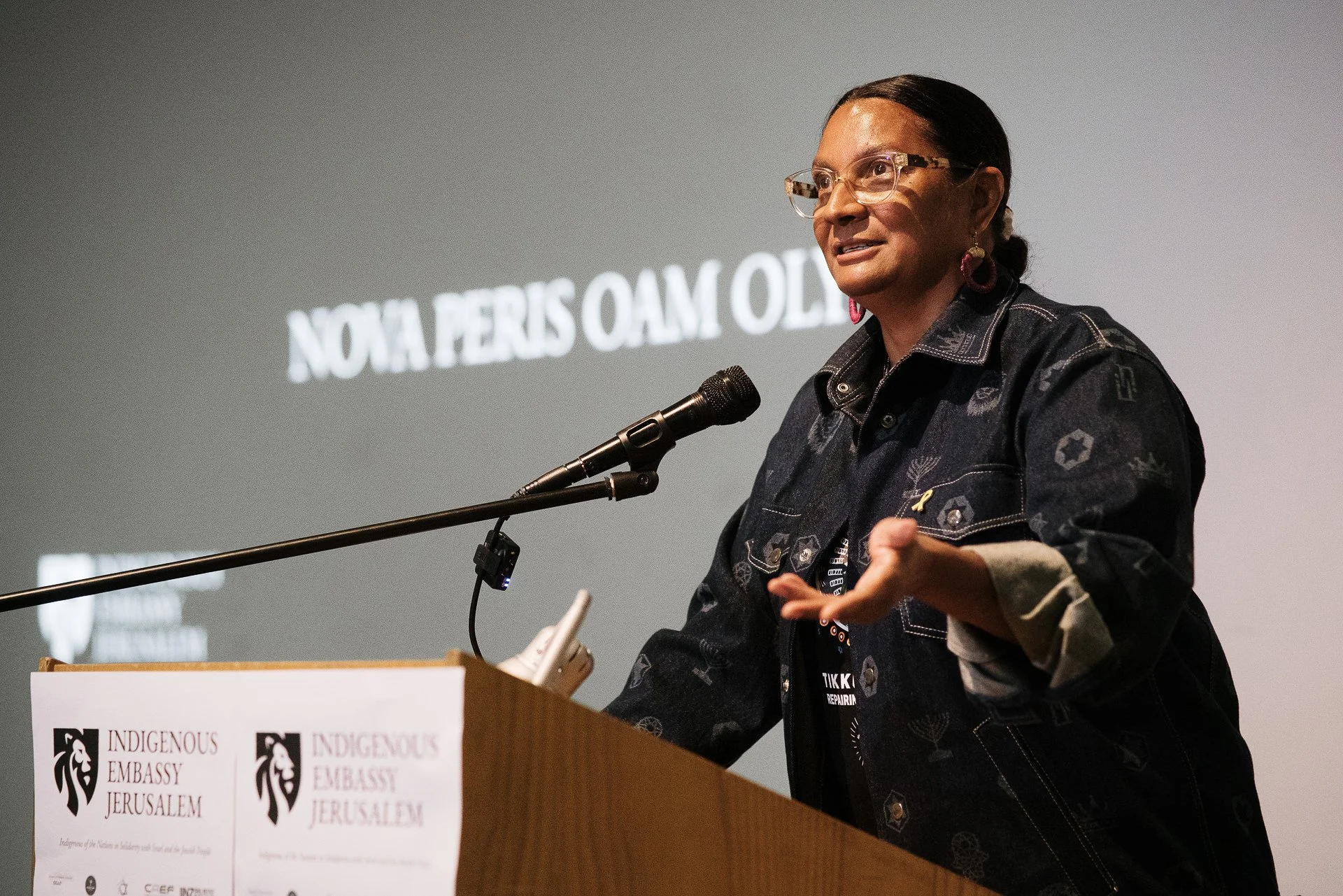
Former Senator and Olympic gold medallist Nova Peris has submitted a deeply personal and historically grounded submission to the Royal Commission into Antisemitism and Social Cohesion, arguing that the rise of antisemitism in Australia represents not only a threat to Jewish Australians but a profound challenge to the nation’s democratic values and social cohesion.
Drawing on her experiences as an Aboriginal woman, elite athlete, parliamentarian and anti-racism advocate, Peris argues that antisemitism should not be viewed as a problem affecting only one minority community. Rather, it is an Australian problem that tests whether the country is prepared to defend the dignity and safety of all its citizens.
At the heart of the submission is a powerful theme of memory and gratitude. Peris asks a question that recurs throughout the document: “How do we forget those who lifted us?”
She argues that contemporary debates about Israel and the Jewish community have obscured a remarkable chapter in Australian history—the significant contribution Jewish Australians made to Aboriginal advancement. The submission highlights the work of leading Jewish lawyers such as Ron Castan and Ron Merkel, whose roles in the Mabo litigation, native title law and the founding of the Victorian Aboriginal Legal Service helped transform the legal position of Aboriginal Australians. It also recalls the involvement of Jewish students in the 1965 Freedom Ride alongside Charlie Perkins, arguing that these acts of solidarity deserve greater recognition in Australia’s national story.
Peris expresses disappointment that some Aboriginal organisations have adopted strongly anti-Israel positions while, in her view, overlooking the historical support Jewish Australians provided to Indigenous communities. She argues that acknowledging Jewish contributions to Aboriginal justice is not about taking sides in the Middle East but about remembering those who stood alongside Aboriginal Australians during some of their most important civil rights struggles.
Another major theme of the submission is the relationship between Indigenous identity and Jewish history. Peris argues that Aboriginal Australians, perhaps more than most people, understand concepts such as ancestral connection to land, language, culture and historical continuity. For that reason, she believes Indigenous Australians should be well placed to recognise the Jewish people’s enduring connection to the land of Israel.
She rejects the increasingly common portrayal of Jews as foreign colonisers, arguing instead that Jewish indigeneity is supported by archaeology, historical records, religious tradition and the continuous survival of Hebrew. In her view, denying that history is not merely an academic error but contributes to contemporary antisemitism by portraying Jews as illegitimate outsiders in their ancestral homeland.
The submission also documents Peris’s growing concern following the Hamas attacks of 7 October 2023. She describes those attacks as a turning point that exposed a rapid rise in antisemitism within Australia.
For Peris, the alarming increase in antisemitic incidents are not isolated events but form part of a broader erosion of Australia’s social cohesion. She argues that hatred directed against one community ultimately weakens the safety and unity of society as a whole.
Peris acknowledges the personal cost of publicly supporting the Jewish community. She describes receiving sustained online abuse, being labelled a “sell-out” by some Aboriginal activists, and reporting threats to police. Despite this, she says many Aboriginal elders and community members privately expressed support, recognising parallels between Aboriginal concepts of Country, identity and the Jewish historical attachment to Israel.
Peris calls for stronger teaching of Jewish history, greater public understanding of Jewish indigeneity, wider adoption of the International Holocaust Remembrance Alliance’s working definition of antisemitism across Australian sporting organisations, improved protection for Jewish schools and community institutions, and formal recognition of the shared history between Jewish Australians and Aboriginal Australians.
Rather than presenting antisemitism solely as a law enforcement issue, Peris argues that combating it requires historical literacy, moral consistency and public leadership. Throughout the submission, she returns to a simple proposition: Australians should remember those who stood beside Aboriginal people in their struggle for justice and ensure that prejudice against Jewish Australians is confronted with the same moral clarity expected for every other form of racism.
Ultimately, Peris frames her submission as an appeal to Australia’s collective memory. Her central argument is that social cohesion depends not only on protecting vulnerable communities today but on remembering the alliances that helped build a more just nation in the past. Forgetting that shared history, she suggests, risks allowing new forms of prejudice to flourish where old lessons have been lost.
Read the full submission:
PERSONAL SUBMISSION TO THE ROYAL COMMISSION ON ANTISEMITISM AND SOCIAL COHESION
Standing With the Jewish Community, and Remembering; Those Who Lifted Us
Submitted by Nova Peris OAM OLY
Olympic Gold Medallist · Former Senator for the Northern Territory
Covering Letter
Dear Commissioner,
On 14 December 2025, more than a thousand people gathered at Bondi Beach to celebrate the first night of Hanukkah. Among them were families with young children, grandparents, Holocaust survivors and a visiting rabbi who had travelled to Australia to ask our leaders to do more about antisemitism. That evening, two gunmen opened fire. Fifteen people were murdered. Many more were wounded. It was the deadliest mass shooting in Australia since Port Arthur, and it was, in the words of our own Prime Minister, an act of antisemitic terrorism on Australian soil. The youngest victim was a ten-year-old girl named Matilda. She had been enjoying a petting zoo with her parents and her little sister when she was shot. Her family had come to Australia from Ukraine, as so many families come here, for a good life and for safety. Days later, hundreds of mourners watched a tiny white coffin carried from a synagogue while people clutched teddy bears and bumble-bee shaped balloons. I cannot forget that her schoolmates gave her an Aboriginal nickname, “wuri wuri” the little ray of sunshine. A Jewish child whose family came from Ukraine, she was born in Australia, and her parents gave her the most Aussie name ‘MATILDA’ and she is remembered with an Aboriginal word for light. That is the Australia I believe in, and that is the Australia we are at risk of losing. I make this submission because social cohesion is not an abstract idea to me. It is the thing that allowed a young Aboriginal mother from the humble beginnings of a Housing Commission flat in Darwin, go on to represent her country, and it is the thing that should allow a Jewish child to celebrate her faith on a public beach without being murdered for it.
When one community can be hunted, every community is diminished. Antisemitism is not a Jewish problem. It is an Australian problem, and it threatens the dignity, safety and unity that all of us depend upon. Social cohesion is not built by policy alone. It is built person to person, in the curiosity and respect that ordinary Australians show one another across lines of race, religion and background. I have spent my life on the side of that work in sport, in public life and in reconciliation. I have seen how quickly it can be undone when hatred is excused or ignored, and how a silence that begins as discomfort can end in violence.
I do not believe Australians want the country that Bondi revealed to us. But wanting a different country is not enough; we have to be willing to defend it, and to name antisemitism plainly when we see it. I write as an Aboriginal woman whose own family endured dispossession, removal and the policies of an earlier Australia. I write as someone who has stood beside the Jewish community since the atrocities of 7 October 2023, and who has paid a personal price for doing so.
Above all, I write because I know a truth that is now being erased from our public conversation: when Aboriginal people were the oppressed, Jewish Australians stood beside us. They helped dismantle the legal fiction of terra nullius. They helped build our institutions. They marched with us. I cannot stay silent while that history is forgotten and while the same people who helped lift us are demonised in our streets and schools. This submission sets out who I am, what I have witnessed, and why I believe Australia must confront antisemitism honestly, courageously and without fear. I offer it with respect, and in memory of Matilda and all those taken at Bondi.
With respect,
Nova Peris OAM OLY
1. Personal Background, Family, Community and Values
I was born in Darwin on Larrakia Country and raised in a Housing Commission home by my then single mother, Joan Peris, and later my stepfather, who was detective police officer and former Vietnam veteran. My upbringing was shaped by resilience, gratitude, hard work, hard discipline and a belief that every person should be treated with dignity and respect.
My mother was born in Wyndham to my grandparents, Nora and Johnny Peris. Our family has connections to the Gija people of the East Kimberley and the Yawuru people of the West Kimberley. My grandmother, Nora, was a member of the Stolen Generations; her mother was a full-blood Aboriginal woman, and her father was of Scottish-Irish descent.
My grandfather, Johnny, was taken from his family at around six years of age and sent to Beagle Bay Mission, before being transferred to Moola Bulla Mission, where he met my grandmother. He was of Aboriginal and Filipino decent. Both of my grandparents lived under the harsh, restrictive controls imposed on Aboriginal people throughout the Kimberley under the Aborigines Protection Act. They were required to obtain official permission to marry and lived under regulations that governed many aspects of their daily lives. They also lived through World War II and survived the air raids on northern Australia.
My grandmother often spoke of the war years and of the resilience required simply to survive. My grandparents had ten children, four born in the East Kimberley and the rest in Darwin; one child sadly died young. My mother was removed from her family and sent to Garden Point Mission on the Tiwi Islands aged 8, where she spent about eight years of her childhood. After leaving the mission at seventeen she was fostered by an English family, Aunty Jo and Uncle Harold alongside another removed Aboriginal child, Anne. At a time when racial segregation still existed in parts of Australia, mum’s foster parents never saw her or Aunty Anne as a “black children.” They saw them simply as their children and took them everywhere they went because they believed they were equal to everyone else. Their love changed the trajectory of my mother’s life.
My grandmother’s own story is recorded in the book Moola Bulla: Shadows in the Mountains, which I read later in life, and through her I came to understand the profound impact of those government policies on Aboriginal families. Despite everything she endured, my mother never raised my sister and me with bitterness. She made it clear that her experiences belonged to her generation, and she wanted us to focus on the opportunities available to us rather than be trapped by the injustices of the past.
Neither of my grandparents received a formal education; my mother often reflected that when she left Garden Point at seventeen, she had the equivalent of only a Year Four education. That reality shaped her conviction that schooling mattered. She told us repeatedly that education was the one thing nobody could ever take away from us. My glass, she insisted, was always half full, and she pushed us to get out into the world and have a go.
My stepfather entered our lives when I was about eight. He had served two tours of Vietnam and became a senior sergeant detective in the Northern Territory Police, and he brought discipline, structure and accountability into our home. He taught me that nothing comes for free, that hard work matters, and that success is earned through commitment. My childhood was happy. We lived modestly but never felt deprived.
My mother worked hard in the public service, played sport herself, and made sure our family enjoyed experiences she had never been afforded. My younger sister embraced the same values. After Year 11 she joined the Australian Army, where she served for ten years, and she has since spent fifteen years working for the United Nations, including eleven years overseas as a Movements Control and Logistics Officer. Her achievements show what becomes possible when young Aboriginal people are encouraged to dream big.
As for me, I excelled at school, became captain of my primary school, and at fifteen was selected in the Australian Under-16 Schoolgirls hockey team. Even after becoming a mother at nineteen, I never abandoned my dreams, because my family never allowed me to believe my future was limited. Through my biological father our ancestorial connection is to West Arnhem Land and the Kakadu region. Since I was about twenty, I have maintained a strong connection to Arnhem Land and my paternal family.
For more than thirty-five years my brother, Jonathan Nadji, who lives on Country at Cannon Hill, has deepened my understanding of culture, identity and belonging. Through him and my extended Bininj family, many of whom work as rangers caring for Country, I have developed a profound appreciation for our responsibilities to land, community and future generations. Jonathan often reminded me that when I stood on a podium or spoke publicly, I was not only representing myself but also my people, and that having a voice means using it for others who may not have the same platform. That understanding shaped my advocacy from a young age, including my involvement in the campaign opposing the proposed Jabiluka uranium mine, because I understood the importance of protecting Country and respecting the wishes of Traditional Owners. Sitting among rock art dated back tens of thousands of years, I am reminded that my ancestors walked this land for countless generations before me. I once took my Olympic gold medal back to Country to share the moment with Jonathan’s father, my great-uncle, senior Elder Bill Nadji. When Jonathan explained the significance of an Olympic gold medal, my great-uncle compared it to the pride he felt when Traditional Owners regained ownership of their land. It was a powerful reminder that sporting achievement, however important, is ultimately secondary to culture, Country and community.
As Aboriginal people often say, we do not own the land; the land owns us. My DNA confirms what I have always felt: my Irish, Scottish and Filipino ancestries trace to those countries, while my Aboriginal blood traces only to this continent. Aboriginal people are the Indigenous people of this land. The values my family instilled in me were simple but powerful: treat others as you would like to be treated; work hard; show respect; be grateful for opportunity; honour your connection to Country; and never allow yourself to be defined by victimhood. I do not view recognition or achievement through ego or status. I view them as responsibilities. These values have guided me throughout my life, and they remain the foundation of my commitment to building stronger, more cohesive communities for all Australians. Those values found their first real test, and their first real proof, on the sporting field.
2. Sport, Opportunity and Inclusion
I finished Year 12 and began a cadetship in Aboriginal Health. At eighteen, I was pregnant with my daughter Jessica, who was born one week after my nineteenth birthday. I was working in customer service at Telecom at the time and, despite being a very young mother, I never gave up on my dream of representing Australia.
At twenty, as the mother of a one-year-old, I was selected in the Australian Under-21 hockey team. I left Darwin to pursue my Olympic dream and moved to the Australian Institute of Sport, juggling motherhood, elite training and part-time work. It was not always easy as a single mother, but I received tremendous support from the hockey community. I made my debut for Australia in 1993 and went on to play 97 international matches. I won a World Cup gold medal, two Champions Trophy gold medals and an Olympic gold medal. In doing so, I became the first Aboriginal person to win an Olympic gold medal for Australia, and only the second Australian mother to win Olympic gold, after Shirley Strickland in 1956.
When I reflect on my career, I realise how fortunate I was to be part of an extraordinary team. Under coach Ric Charlesworth, our team was deeply inclusive. We lived through what became known as the golden era of Australian women’s hockey, entering the 1996 Olympic final having gone 38 matches undefeated. What stands out most, however, is not the success. It is the genuine respect and inclusion shown towards me as an Aboriginal woman.
In 1994, our Australian team wore an Aboriginal design on our official uniform at the World Cup, and we did so again at the 1995 Champions Trophy. This was long before Reconciliation Action Plans existed. There were no policies requiring it. My teammates embraced my culture because they genuinely wanted to understand it. Many travelled to Arnhem Land with me, visiting the Cobourg Peninsula and the Tiwi Islands, where my mother had grown up on the mission. They wanted to learn about my family, my culture and my history. They did not see these things as differences to be feared; they saw them as something to be celebrated. That experience taught me a lesson I have never forgotten: inclusion begins with curiosity, respect and human connection. We may come from different cultures, religions and backgrounds, but we walk the same earth, breathe the same air and bleed the same red blood.
Of course, racism exists in sport, and I experienced it. I was called several horrible racist names, including being referred to on many occasions as a “black bitch” while competing at Australian Championships. Those experiences were hurtful and, to me, confusing. I could never understand the hatred or why people could despise someone they had never met. Growing up in multicultural Darwin, I had rarely encountered racism. We grew up alongside Greek, Italian, Vietnamese, Aboriginal and non-Aboriginal families, and nobody seemed to care where you came from. What is significant is that I never experienced racism within the Australian team itself. My teammates embraced me, supported me and respected me.
One moment remains deeply meaningful. In 1994, Australia competed in South Africa, the same year Nelson Mandela became President and apartheid ended. On that tour, I played my 50th match for Australia and was appointed captain. I will never forget standing as an Aboriginal woman leading the Australian team onto the field, with teammates behind me who were predominantly white Australians. It was a powerful symbol of what sport can achieve. It allows people to see one another not through race or background, but through shared goals, commitment and teamwork.
Another memorable moment came at the 1996 Atlanta Olympics, when Jana Novotná asked me where I was from. When I replied, “Australia,” she seemed genuinely surprised that a Black woman was representing Australia in the green and gold. That conversation reminded me how little the world knew about Aboriginal Australians. For much of our history, the doctrine of terra nullius the legal fiction that this land belonged to no one rendered Aboriginal people effectively invisible in the national story until the landmark Mabo decision finally overturned it in 1992.
Following our Olympic gold medal victory with the Hockeyroos at the Atlanta Olympic Games in 1996, I retired from hockey to pursue my childhood dream of competing at the Olympics in athletics. Within twelve months, I had made the Australian Athletics Team and represented Australia at the 1997 World Athletics Championships in Athens. The following year, I won two gold medals at the 1998 Commonwealth Games in Kuala Lumpur, claiming victory in the 200 metres and the 4 x 100 metre relay. In 1999, I again represented Australia at the World Athletics Championships before transitioning to the 400 metres and competing at the Sydney 2000 Olympic Games.
I reached the Olympic semi-final in the individual 400 metres and then anchored the Australian women’s 4 x 400 metre relay team in the semi-final, breaking a 24-year-old Australian record. The following day, I led our 4 x 400 metre team off the blocks in the Olympic final alongside Cathy Freeman, Melinda Gainsford-Taylor and Tamsyn Lewis. Together, we set a new Australian record in the Olympic final. More than 26 years later, that Australian record still stands.
Unfortunately, racism did not end when I left hockey. It followed me into athletics. As I recount in my autobiography, while representing Australia I was sitting at a dinner table with fellow athletes when a teammate looked at me and said, “Pass the salt, nigger,” before laughing. The room fell silent. No one challenged him. No one called it out. I remember responding, “Get it yourself,” before leaving the table, returning to my room and crying. At the time, I was eight weeks pregnant and preparing to compete at the 2001 World Athletics Championships in Canada.
I later reported the incident to the head coach. The matter was not dealt with immediately, and I was advised to wait until after the Championships. Upon our return to Australia, we participated in a restorative justice mediation process. His apology began with the words, “I’m sorry, I didn’t realise it was so hurtful to you.” I sat there wondering how anyone could think it was acceptable to refer to an Aboriginal woman in such a degrading and racist manner in the first place.
One of the most damaging aspects of racism is that it often paralyses not only the victim, but also the witnesses. People see it, hear it and know it is wrong, yet too often remain silent. Even when a complaint is made, the burden frequently falls on the person who has been harmed to raise the issue, relive the experience and pursue accountability. This is why I have always believed that combating racism cannot be left solely to those who experience it. It must be a shared responsibility.
Throughout my sporting career, in hockey, athletics, politics, and now as a mother and grandmother, I have consistently spoken out against racism because the standard we walk past becomes the standard we accept. No person should ever be degraded, excluded or vilified because of the colour of their skin, their ethnicity, their religion or who they are.
The same principle applies to antisemitism today. If we are serious about social cohesion, we must be prepared to call out prejudice wherever it occurs and stand together against it. When hatred, extremism and dehumanisation are ignored or excused, the consequences can be fatal. Australia has witnessed this through acts of violent extremism, including the Bondi terrorist attack, which demonstrated the tragic human cost of unchecked radicalisation and hatred.
Through sport, I also came to understand that achievement is never solely about the individual. Every success reflects the sacrifices, encouragement and support of family, community and culture. When one person stands on a podium, many people stand behind that achievement. It is a lesson I carry into everything I do, including this submission. I do not speak only for myself, and the things worth defending are never defended alone.
I represented this nation for thirteen years in the Australian uniform, and I never saw myself as representing only Aboriginal people. I represented all Australians. My mother taught me to embrace every opportunity while never forgetting where I came from, whose shoulders I stood upon, and those who helped pave the way.
My experience in hockey showed me what genuine inclusion looks like. It was not driven by policy; it was driven by respect, friendship, curiosity and shared humanity. Those same principles remain essential today if we are serious about combating racism, antisemitism and all forms of hatred.
My experiences in sport taught me the value of inclusion and the cost of hatred. Those lessons shaped how I responded when I witnessed the rise of antisemitism in Australia following October 7.
3. October 7, Australia and the Rise of Antisemitism
On 7 October 2023, thousands of Hamas terrorists and other militants launched a coordinated land, sea and air assault on Israel from the Gaza Strip. They attacked civilian communities, military bases and the Nova music festival in what became the deadliest day for the Jewish people since the Holocaust. The attacks involved the murder of civilians, including children and the elderly, the taking of hostages, acts of sexual violence, torture, the burning of homes and the desecration of bodies.
Subsequent investigations by the United Nations, human rights organisations and forensic authorities have documented extensive evidence of rape, hostage abuse, arson and mutilation. What shocked me most was not only the barbarity, but the fact that many perpetrators proudly filmed their crimes using body cameras, phones and social media, some broadcasting live. The world did not learn of these atrocities through rumour; much of the evidence was recorded and distributed by the perpetrators themselves. These events struck Australia at an unusually raw moment. October 7 fell exactly one week before the Voice Referendum on 14 October.
As an Aboriginal woman deeply involved in the national conversation about the referendum, I was already processing significant emotion and uncertainty about the future of reconciliation. The day after the referendum, my mother attended church, where elderly Aboriginal people asked her, “What does this mean? Can we not be proud to be Aboriginal in our own country anymore?” It was a difficult and emotional period for many Indigenous Australians.
At the same time, I was watching the horrifying reports emerging from Israel. Then, within twenty-four hours of the massacre, on 8 October, public celebrations occurred in Lakemba. At that point Israel had not yet launched any military response. Israeli civilians were still being hunted, hostages were still being taken, and families were desperately trying to learn whether their loved ones were alive.
This timing matters profoundly. The celebrations were a reaction to the slaughter of civilians, not to any subsequent war. The events of 7 October were not resistance against military targets; they were a deliberate attack on children, babies, women, the elderly, foreign nationals and peace activists, many murdered in their homes or at a music festival. I found this deeply confronting and sickening.
Australia is a nation built on respect for human dignity, the rule of law and social cohesion. Whatever one’s views on the Israeli–Palestinian conflict, celebrating the deliberate murder, rape, torture and kidnapping of civilians should never be acceptable in any Australian community, or in any country. As someone who has spent much of my life advocating for reconciliation and inclusion, I found it incomprehensible that such celebrations could occur on Australian soil in response to the largest massacre of Jewish people since the Holocaust. To me it was one of the most disturbing examples of moral and leadership failure I have ever witnessed. The apparent absence of immediate condemnation sent a troubling message: that celebrations of anti-Jewish violence were being tolerated in ways that would never be acceptable if directed at any other community.
For many Australians, including me, Lakemba was an early warning sign of the division and hatred that would become increasingly visible in the months that followed. Less than forty-eight hours later, on 9 October, I watched scenes unfold outside the Sydney Opera House. People in Australia appeared to be celebrating one of the worst mass killings of Jews since the Holocaust. Much of the subsequent public debate fixated on whether particular words had been chanted “Gas the Jews” or “Where’s the Jews?” In my view that distinction misses the point entirely. The horror lies in the fact that people were openly targeting Jews at one of our most iconic national symbols.
History teaches us where such hatred leads. The Holocaust did not begin with gas chambers. It began with the dehumanisation of Jewish people, the normalisation of hatred, and the willingness of others to remain silent. Over the following weeks many Jewish friends contacted me. Throughout my life I had never defined people by their race or religion I had Jewish friends, colleagues and supporters, but I thought of them simply as my friends. Now they were asking a single, painful question: “Where are our friends?” I told them I wanted to understand fully before speaking publicly, to listen and learn rather than react on assumptions. As I did, I became increasingly alarmed. I watched as Aboriginal people and Aboriginal causes were drawn into a conflict occurring thousands of kilometres away. I saw activists appropriating the language of our struggle — “genocide,” “apartheid,” “coloniser” and merging it with a foreign political cause. I watched the Aboriginal flag morphed alongside the Palestinian flag. This was deeply personal.
From 2020 to 2022 I devoted two years of advocacy to freeing the Aboriginal flag from copyright so that Aboriginal people would no longer have to pay to use our own flag, which the Australian Government ultimately purchased on behalf of all Aboriginal people. Our flag represents the struggle for land rights, justice and recognition. It has been carried by Yothu Yindi, by Cathy Freeman, and by countless children during NAIDOC and Reconciliation Week. To see it conscripted into an international conflict that has nothing to do with our history was confronting. By 26 January 2024, Australia Day protests traditionally a day for Aboriginal people to advocate for our own communities had in many places been overtaken by the Israel–Gaza conflict. People were using our day, our flag, our struggle and the blood of our ancestors to advance an agenda that was not ours. I believe this has done real damage to reconciliation.
On 1 December 2023 I published my first opinion piece in the Herald Sun expressing these concerns. At that stage I had never been to Israel and made no claim to expertise on Middle Eastern politics. Within days I received thousands of messages from Jewish Australians thanking me for speaking out, many expressing fear and frustration that so few public figures would condemn antisemitism with clarity.
What disturbed me most was not only the rise in antisemitism itself, but the unwillingness of many in activist and progressive movements to condemn it, including a reluctance to acknowledge the sexual violence committed against Jewish women and girls on October 7. Human rights must be universal. Compassion cannot depend on the identity of the victim. Violence against women is wrong regardless of who commits it or who suffers it.
In March 2024 I travelled to Israel for the first time. What I witnessed changed me. I visited sites attacked on October 7, listened to survivors, and met grieving families. I have never been someone led by slogans; I believe in seeing things for myself before forming conclusions. What I saw reinforced my belief that hatred and radical ideology have no place in Australia, and strengthened my resolve to defend social cohesion, mutual respect and peaceful coexistence.
The rise in antisemitism since October 7 has not only harmed Jewish Australians; it has damaged the cohesion of our entire nation, creating fear, division and distrust. The Jewish community deserved better. My concern about antisemitism was strengthened further when I began examining the historical relationship between Jewish Australians and Aboriginal advancement a relationship that too many of our own institutions now seem willing to forget.
4. The Jewish Contribution to Aboriginal Advancement: How Do We Forget
Those Who Lifted Us? One of the most painful questions I have had to ask myself is this: how do we forget those who helped lift us? I ask because I have been deeply troubled by statements issued by the Victorian Aboriginal Legal Service and the Aboriginal Legal Service NSW/ACT in the months after the 7 October attacks. On 8 December 2023, the Victorian Aboriginal Legal Service (VALS) released a statement declaring solidarity with Palestinians; while it condemned Hamas, it went on to frame Israel’s response as “apartheid” and “colonial state violence.” Then, on 25 January 2024, on the eve of Survival Day, the Aboriginal Legal Service NSW/ACT released its own statement in solidarity with Palestinians.
As an Aboriginal woman, I found this profoundly disappointing not because Aboriginal people should be silent about human suffering, but because these statements seemed to erase an important truth. Jewish Australians have made a profound contribution to Aboriginal justice, land rights, human rights and the dismantling of terra nullius, Australia’s greatest legal lie. And Israel is the ancestral homeland of the Jewish people. VALS itself was founded in 1973 by Jim Berg, Ron Merkel KC and Ron Castan AM QC. Jim Berg was an Aboriginal activist and community leader without a legal background. The legal brilliance came from two extraordinary Jewish lawyers, Ron Merkel and Ron Castan. Together they helped create the first free legal service of its kind in Victoria. VALS itself acknowledges them as founders, and both later stepped down from their board positions, personally recognising that VALS should be governed by an Aboriginal board. That history fundamentally matters. Merkel and Castan did not simply support Aboriginal people from a distance; they used their training, advocacy and professional standing to help build an Aboriginal-controlled institution that still exists today. So when VALS issued its statement in 2023, knowing how many Jewish Australians experienced it as a moral blow, I could not help but ask: how quickly do we forget?
Ron Castan AM QC (1939–1999)
Ron Castan was one of the most important barristers in Australian legal history, a brilliant legal mind matched by a compassionate heart. He was Jewish, the son of Russian Jewish immigrants, and became one of the great human rights advocates this country has produced. His name should be permanently remembered in Aboriginal history. Castan was lead counsel for Eddie Koiki Mabo in the landmark Mabo case the case that destroyed the doctrine of terra nullius and recognised that Aboriginal and Torres Strait Islander peoples held native title rights that existed before British settlement. Without Mabo, Australian law would still rest on the fiction that this land belonged to no one. Ron Castan appeared in or contributed to many of the cases that built modern Indigenous law, including:
• Mabo v Queensland (No 2) — overturned terra nullius and recognised native title.
• Koowarta v Bjelke-Petersen — a major racial discrimination and land rights case.
• Commonwealth v Tasmania (the Tasmanian Dam Case) — important for environmental law, constitutional law and Indigenous heritage protection.
• Wik Peoples v Queensland — he helped conceive and draft the case that found native title could coexist with pastoral leases.
• Native Title Act advocacy — throughout the 1990s he worked to defend native title protections from being weakened. Chief Justice Richard Niall, in May 2026, specifically recognised Castan as lead counsel for Eddie Mabo and noted that he appeared in so many leading cases and won.
Ron Merkel KC
Ron Merkel, also Jewish, was another of the founding legal minds behind VALS. He later became a Federal Court judge and was widely respected as a human rights lawyer. His key contributions included co-founding VALS with Jim Berg and Ron Castan; appearing for the plaintiff in Roach v Electoral Commissioner, a major High Court case that restored voting rights to thousands of incarcerated Australians, which Chief Justice Niall described as a critical case about voting rights and the franchise; and wide-ranging human rights advocacy across constitutional, public law and social justice matters.
Jeff Sher QC
Jeff Sher QC was another legendary Jewish barrister of the Victorian Bar, described by Chief Justice Niall as a legend of the Bar who appeared in High Court cases involving defamation, common law and criminal law. His Indigenous land rights work included appearing in the High Court in Wik Peoples v Queensland, intervening for the Northern Land Council and Central Land Council; acting as senior counsel for the Northern Land Council in the Kenbi Land Claim; the Jawoyn (Katherine Gorge) land claim; and the Ranger uranium mining agreements challenge. His work helped advance the legal struggle over land, native title and Aboriginal rights in the Northern Territory and beyond.
Other Jewish lawyers who shaped human rights in Australia
The contribution extends well beyond Aboriginal land rights. Alan Goldberg QC, who had an enormous commercial practice, also appeared in major human rights litigation including Croome v Tasmania, a High Court challenge to Tasmania’s laws criminalising homosexuality that helped lead to their repeal. Maurice Ashkanasy QC, who rose from modest means to become Chairman of the Bar, appeared for Albert Namatjira in the High Court in Namatjira v Raabe an early instance of a Victorian barrister appearing for a First Nations person before the High Court and in Briginshaw v Briginshaw, still cited today on the standard of proof. Joan Rosanove QC was the first woman to sign the Victorian Bar Roll in 1923 and later Victoria’s first female Queen’s Counsel, breaking barriers for women in a profession that was overwhelmingly male; the next two female silks in Victoria, Lynnette Schiftan and Ada Moshinsky, were also Jewish. Chief Justice Niall also acknowledged a wider group: Sir Isaac Isaacs, High Court justice and Australia’s first Australian-born Governor-General; Elias “Bill” Coppel QC, who appeared in more than ninety High Court cases; Sam Cohen KC, Australia’s first Jewish senator; Bill Kaye, a fierce advocate and later Supreme Court judge; Mark Weinberg, an outstanding barrister and judge; Robert Richter, a major criminal barrister; and Mark Dreyfus and Linda Dessau for their public and legal service. The Chief Justice was careful to say he did not know how far Judaism shaped each of their professional lives, and that some may not have wished to be defined only as Jewish barristers. But he also said it could not be a coincidence that such a small community had so profound and positive an influence on the Bar and the work of the High Court. That is precisely the point: a small community, an enormous contribution.
Jim Spigelman and the Freedom Ride
This history did not begin with Mabo. In 1965, Charlie Perkins led the Freedom Ride through New South Wales to expose racism, segregation and discrimination against Aboriginal people. Charlie Perkins was the central Aboriginal leader, with Gerry Mason also among the small number of Aboriginal participants, and Gary Williams later joining at Bowraville. But one of the key organisers was Jim Spigelman, a Jewish student who would go on to become Chief Justice of New South Wales. Charlie Perkins described Spigelman as extremely active in organising the ride and on the ride itself his “right-hand man.” Another seven Jewish students were also part of the Freedom Ride alongside Charlie and Jim. The Freedom Ride exposed segregation at swimming pools, exclusion from RSLs, discrimination in housing and the daily humiliation faced by Aboriginal people. It was not symbolic; it changed the national conversation. And once again, Jewish Australians were there — not as oppressors, but as allies in one of the most important chapters of the Aboriginal and Torres Strait Islander fight for justice.
Why this matters now
This is why I cannot stay silent when Aboriginal organisations erase this history. The Jewish contribution to Aboriginal justice is not minor; it is profound. Jewish lawyers helped establish VALS. They helped dismantle terra nullius. They helped build the legal architecture of native title and stood in the High Court, in the hardest cases, against some of the most powerful interests in the country. Jewish students stood with Charlie Perkins on the Freedom Ride. Jewish Australians helped us when we were the oppressed. So how can Aboriginal organisations now speak about Jewish people only through the language of colonisation and oppression? How can they speak of solidarity while forgetting those who showed solidarity with us? The Jewish people are indigenous to the land of Israel, and their ancient language is Hebrew. As Aboriginal people, we know that language is not a minor thing. Language is identity. Language is Country. Language is memory. Language is proof of belonging. We identify ourselves through our language groups, and we know what it means for a people to carry an ancient language through suffering, exile and survival. That is why it is so painful to see Jewish identity erased, and why it is so painful to see Aboriginal struggle used as a weapon against Jewish people. We can care about Palestinian suffering without denying Jewish history. We can call for peace without erasing October 7. We can speak about justice without forgetting the Jewish Australians who helped us achieve justice. Gratitude is not weakness, and memory is not betrayal. The whole story is this: many Jewish Australians stood beside Aboriginal people in our greatest legal and civil rights battles. They helped lift us, empower us, and dismantle terra nullius. We should never forget them. We should honour them. I do not raise this history to score a point. I raise it because the way a country treats the people who once helped its most vulnerable says something about its character. When Aboriginal organisations describe Jewish people only as colonisers, and when the contribution of men like Castan, Merkel and Spigelman is written out of our story, it does not only insult their memory. It feeds the very narrative that Jews are foreign oppressors with no rightful place that is now being used to justify hatred and violence against Jewish Australians in our streets, our universities and, as we saw at Bondi, on our beaches. Remembering who lifted us is not nostalgia. It is part of how we refuse that narrative and protect a community that protected us.
5. The Jewish Community Since October 7
Following my opinion piece on 1 December 2023, and after receiving thousands of emails and messages from Jewish people, not only across Australia but around the world. Many wrote simply to say thank you for speaking with compassion and clarity about the atrocities of October 7 and the rising hostility Jewish people were experiencing. My article appeared just one day after Australia witnessed an incident that should have shocked the conscience of the nation. Family members of Israelis who had been murdered or taken hostage on October 7 were staying at Melbourne’s Crowne Plaza Hotel while visiting Australia to raise awareness of their loved ones and advocate for the release of the hostages. Instead of compassion, they were confronted by around twenty pro-Palestinian protesters who entered the lobby with signs, flags and a megaphone. The protest was so intimidating that members of the Israeli delegation reportedly sought refuge in a nearby police station. Even Prime Minister Anthony Albanese condemned it as “beyond contempt.” These were not politicians or soldiers. They were mothers, fathers, siblings and relatives of people who had been brutally murdered, they were kidnapped grieving families seeking support. For many in the Jewish community, the incident reinforced a deeply unsettling reality: that even in Australia, they could not escape the hatred that has followed them throughout history. In mid-December 2023 I spoke at a Jewish community gathering, where I offered my condolences first and foremost, reminded those present that they are loved, and acknowledged their contribution to our nation-building. In March 2024 I travelled to Israel and afterwards took part in many interviews about what I had witnessed. Upon my return, in May 2024, the nation watched as Melbourne’s Mount Scopus Memorial College, one of Australia’s largest Jewish schools, was targeted with antisemitic graffiti: the words “Jew Die” sprayed across the school’s entrance fence. Three days later I met the principal at an event and told him I wanted to speak with the students. On 3 June 2024, Mabo Day, at the close of National Reconciliation Week I visited the school. What I encountered left a lasting impression. As I approached, I passed through security gates and checkpoints unlike anything I had ever associated with an Australian school. It felt less like entering a place of learning than entering a heavily secured facility. There were security guards protecting schoolchildren in Australia, the lucky country. They were there because hatred of Jews runs so deep that a Jewish school requires extraordinary measures to keep its students safe. I stood there and realised I had never fully understood what so many Jewish families in the diaspora experience every day. It broke my heart. As an Aboriginal woman I have experienced racism, and my family has experienced discrimination. But standing at that school, looking at those children, I was confronted by a reality I had never personally witnessed: children attending school under the shadow of hatred directed at them simply for being Jewish. I became emotional speaking to the students. I cried, because I could see the fear and the burden these young people were carrying. No child should grow up wondering whether they are safe because of their identity. Since that day I have continued to speak at synagogues, community events and educational forums, because I want Jewish Australians to know they are loved, valued, seen, and that they belong. The Jewish community has contributed enormously to this country from Sir Isaac Isaacs and Sir John Monash, arguably our greatest military leader, to the thousands of Jewish Australians who have served in our armed forces and the many who have shaped our medicine, science, law, education, business and public life. Yet today Jewish children attend school behind security fences, parents worry about the school run, and synagogues and community centres require protection. What troubles me most is that much of this hatred was allowed to grow unchecked. Leadership matters. When antisemitism is minimised, excused or ignored, hatred becomes normalised. Week after week Australians witnessed antisemitic incidents, intimidation and threats, and too often the response lacked urgency and moral clarity. The phrase “Never Again” emerged after the Holocaust as a promise to future generations. For many Jewish people, “Never Again Is Now” reflects the fear that the lessons of history are being forgotten. As an Indigenous Australian, I see in the Jewish story a people who endured persecution, exile and attempted annihilation yet kept their identity across millennia. That history deserves respect, not hatred. Yes, Aboriginal Australians continue to face disadvantage, racism and injustice, and there remains much work to do. But in contemporary Australia we do not see weekly public demonstrations calling for the death of Aboriginal people, and we do not see schools targeted because the children are Aboriginal. Jewish Australians have faced precisely these forms of hatred, and that should alarm every decent Australian. My mother’s words remain with me every day: “Haven’t the Jews suffered enough? When does it stop?” It stops when the majority refuses to remain silent. It stops when political leaders show courage. It stops when institutions enforce consequences. It stops when ordinary Australians speak up. History teaches us that hatred flourishes when good people stay silent. The safety, dignity and inclusion of Jewish Australians is not a Jewish issue. It is an Australian issue. I did not understand the full weight of my mother’s question until 14 December 2025. The fear I had seen behind the security fences at Mount Scopus was no longer a possibility to be guarded against; it had become a massacre on one of our most famous beaches, on the first night of Hanukkah, with a ten-year-old among the dead. Everything I had witnessed in the two years before Lakemba, the Opera House, the Crowne Plaza, the graffiti reading “Jew Die” had been warnings. They were not heeded with enough urgency. I include them in this submission so that they are recorded not as isolated incidents, but as the steps of a path that led, terribly, to Bondi. Standing with the Jewish community came at a personal cost. But it also led me to a place where the shared history of our two peoples is written into the very ground, Israel.
6. Israel, Semakh and the Aboriginal Light Horse
When I first set foot in Israel, the online abuse began almost immediately and intensified rapidly. It seemed many people had already made up their minds about Israel and the Jewish people without ever having seen the country, spoken to Israelis, or understood the history. The dominant narrative they had accepted was that Jews were colonisers and oppressors, and anyone who challenged it became a target. I became the subject of sustained online abuse, vilification and intimidation because of my public support for Jewish Australians and my belief that Israel, like any sovereign nation, has the right to exist and to defend its citizens from terrorism. Much of the hostility came from a vocal group of Aboriginal activists, particularly from the eastern states. What struck me was how sharply this contrasted with the views of many Aboriginal elders, language speakers and people deeply connected to Country, culture and community. Many of them understood the Jewish story through the lens of their own Indigenous experience ancestral connection to land, the preservation of culture across generations, and the enduring bond between a people and their homeland. Some had travelled to Israel on pilgrimage; others simply understood that Indigenous identity is inseparable from history, culture, language and place. My own mother, raised on a Catholic mission, was often bewildered by claims circulating online that “Jesus was Palestinian.” Her response was always simple: “Jesus was a Jew.” She would remind me that the inscription above the cross, INRI, stands for Iesus Nazarenus, Rex Iudaeorum — Jesus of Nazareth, King of the Jews. As I grew more vocal, the abuse escalated. I received messages telling me to “neck myself.” I was called a “sell-out” and accused of betraying Aboriginal people; others demanded I “come back to my people.” Some of these messages came from people who had previously supported my work. The abuse extended well beyond social media to threatening emails and repeated attempts to intimidate me into silence, serious enough that I reported matters to law enforcement, including the Australian Federal Police, and was at times asked whether I required additional security. Yet alongside the abuse, I was experiencing something very different from Aboriginal people who understood the historical relationship between Aboriginal Australians, the Australian Light Horse and the land of Israel. In 2025 I travelled to Israel to receive an award from the President of the Technion as one of four global citizens recognised for fighting antisemitism. I then joined a delegation of First Nations representatives, and together we witnessed a moment of profound significance: for the first time, the Aboriginal flag was raised alongside the Australian and Israeli flags at the Australian Light Horse Memorial Garden at the historic Semakh Railway Station on the shores of the Sea of Galilee. Standing there with five other First Nations delegates was deeply moving. The memorial honours the service and sacrifice of Australian Light Horse soldiers who fought in the Middle East during the First World War, among them Aboriginal servicemen whose contribution has too often been overlooked. More than 500 Indigenous Australians served in the First World War, of whom 118 served in the Australian Light Horse. Particularly significant was the 11th Light Horse Regiment, 20th Reinforcement, known as the “Queensland Black Watch” the only exclusively Aboriginal formation in the Australian Imperial Force during the Great War. Historical records identify at least twenty-six Aboriginal men who joined the 11th Light Horse, many from Queensland mission communities. At Semakh we stood before the statue of Trooper Jack Pollard, one of those servicemen. To see the Aboriginal flag flying over a site where Aboriginal Australians had fought and sacrificed more than a century earlier was a powerful reminder that our history is intertwined with this land. Descendants of Jack Pollard later contacted me to thank our delegation for visiting, flying the flag and helping return his story to the historical map where it belongs. This connection is not new. In April 2024, Reverend Leslie Baird of Yarrabah wrote to Queensland politician Bob Katter expressing concern about Australia’s posture towards Israel, reminding Australians that many families in Yarrabah are descendants of Aboriginal servicemen who fought in the Light Horse campaigns in the Middle East, and questioning why Australia would turn its back on a nation bound to so much shared sacrifice. I was reminded of that same sentiment at an Aboriginal Women’s Leadership gathering in Yarrabah. After I spoke about Israel and the abuse, I had received for standing with Jewish Australians, many of the women expressed support, speaking proudly of the Aboriginal Light Horsemen and the contribution their ancestors had made. They understood the significance of Jack Pollard, of Semakh, and of an enduring connection to ancestral land and history. That experience reinforced something I had increasingly come to recognise: the loudest voices online do not necessarily represent the views of all Aboriginal people. Many Aboriginal people particularly elders, language speakers and those deeply connected to Country understand the importance of history, identity, belonging and ancestral connection, and they recognise those values not only within Aboriginal culture but also within the story of the Jewish people. Despite the abuse, I have continued to speak publicly because truth matters. Jewish people are not colonisers in their own ancestral homeland; they are an Indigenous people who have maintained an enduring connection to the land of Israel throughout history, supported by extensive archaeological, historical, cultural and religious evidence. I include my experience here not to seek sympathy. My experience pales beside what many Jewish Australians have endured. I include it because it demonstrates how quickly hostility can be directed at anyone who publicly supports Jewish Australians, and it highlights the broader environment of intimidation and misinformation that has emerged in Australia since 7 October 2023. The Aboriginal people who stood beside me at Semakh, who honoured Jack Pollard and remembered the Queensland Black Watch, reminded me that truth, history and shared sacrifice still matter. Those voices deserve to be heard too.
7. Historical Context: Jewish Indigeneity and the Australian Connection
One of the most dangerous falsehoods now spreading across social media is the claim that Jewish people are “white colonisers” with no ancestral connection to the land of Israel. This is not history; it is political propaganda. The Jewish connection to the land of Israel is ancient, continuous and supported by religious texts, archaeology, historical records and lived cultural memory. Long before Islam, the Ottoman Empire, the British Mandate and the modern State of Israel, Jewish people were already living, worshipping, writing, building and burying their dead in the land. As Aboriginal people who measure belonging through language and connection to place, we should be among the first to recognise what that means. A basic timeline makes the depth of that connection clear:
– c. 1000 BCE — Jerusalem becomes the capital of the ancient Israelite kingdom under King David.
– c. 957 BCE — The First Temple is built in Jerusalem by King Solomon.
– 586 BCE — The Babylonians destroy the First Temple, and many Jews are exiled to Babylon.
– 516 BCE — The Second Temple is completed after the return from exile.
– 70 CE — The Romans destroy the Second Temple. The Western Wall, the part of the Temple Mount retaining wall, closest to where the Temple once stood, becomes a site of worship for the Jewish people.
– 638 CE — Muslim armies conquer Jerusalem, more than 500 years after Jesus and nearly 600 years after the destruction of the Second Temple.
– 691–692 CE — The Dome of the Rock is built on the Temple Mount.
– c. 705 CE — Al-Aqsa Mosque is built on the same sacred platform. In other words, the major Islamic structures in Jerusalem were built centuries after the Jewish Temples had stood there. The archaeology of Jerusalem and the wider land of Israel Hebrew inscriptions, ancient seals, ritual baths, coins, synagogues, burial sites and Temple-period roads is physical evidence of Jewish civilisation in the land, not myth. To deny Jewish indigeneity to Israel is to deny thousands of years of history. There is one dimension of this history that, as an Aboriginal woman, I feel especially keenly: language. Hebrew is among the oldest continuously connected languages on earth, carried through exile and persecution for thousands of years and then revived as a living, everyday tongue in the modern State of Israel. Aboriginal Australians understand exactly what that represents. We have watched our own languages suppressed and very nearly lost, and we have devoted enormous effort to reviving and protecting them, because we know that language is not decoration. Language is identity, memory and proof of belonging to a place. A people who has kept and revived an ancient language are no strangers to the land that language describes. To deny the Jewish connection to Israel, while we ourselves fight to reclaim our languages and our connection to Country, is a contradiction I cannot accept. Even the Quran repeatedly refers to the Children of Israel, Bani Isra’il, recounting their prophets, covenants and the Exodus from Egypt; Moses (Musa) is its most frequently mentioned prophet, and Abraham (Ibrahim) and Jesus (Isa) are also central figures. By contrast, the word “Palestine” does not appear in the Quran, nor does Jerusalem appear by name. The Quran was revealed to the Prophet Muhammad between roughly 610 and 632 CE, almost six centuries after the life of Jesus and centuries after the destruction of the Second Temple. It did not create the story of the Children of Israel; it refers to a people and a sacred history that were already ancient by the seventh century. Understanding this chronology is not about diminishing Islam. It is about recognising that the Jewish connection to the land and to Jerusalem predates the Muslim conquest and the construction of the Islamic holy sites. Australia has its own connection to this history. From 1517 to 1917 the region was controlled by the Ottoman Empire. During the First World War, Australian soldiers played a critical role in the Middle East campaign. The Battle of Beersheba on 31 October 1917, led by the courage of the Australian Light Horse, helped break the Ottoman defensive line and opened the way to Jerusalem. The ANZAC spirit was not forged only at Gallipoli; it was also forged in the deserts of the Middle East, at Beersheba, Gaza, Semakh and Jerusalem. As I mentioned earlier, Aboriginal servicemen were part of that story, and the “Queensland Black Watch,” the 11th Light Horse Regiment, 20th Reinforcement, remains a powerful example of Aboriginal service and sacrifice. Another important factor is this. Following the defeat of the Ottoman Empire in the First World War, the League of Nations approved the British Mandate for Palestine in 1922. The Mandate incorporated the Balfour Declaration, recognising the establishment of a national home for the Jewish people while protecting the civil and religious rights of all inhabitants of the territory.
Understanding the history of the name “Palestine” is important because it sits at the heart of many contemporary misunderstandings about Jewish identity, Jewish indigeneity and the origins of the modern conflict.
Long before the rise of Christianity, Islam, the Arab conquests, the Ottoman Empire or the British Mandate, the land was known as the Kingdom of Israel and later the Kingdom of Judah (Judea), the ancestral homeland of the Jewish people. Jewish kingdoms existed there, Jewish kings ruled there, Jewish prophets preached there, and Jewish communities lived, worshipped and buried their dead there for centuries.
Following a series of Jewish revolts against Roman rule, culminating in the Bar Kokhba Revolt of 132–135 CE, the Roman Emperor Hadrian sought to suppress Jewish resistance and sever the association between the Jewish people and their homeland. Following the revolt, the Romans renamed the province of Judea as Syria Palaestina.
The name was derived from the Philistines, an ancient people associated with the southern coastal region who are believed to have originated from the Aegean world, including Crete. In the Hebrew Bible, the Philistines were longstanding enemies of the ancient Israelites. Some scholars trace the etymology to the Hebrew root liflosh “to invade” from which the term Philistinim (Philistines) is derived. The Philistines settled along the southern coastal plain and hinterland of what is today the Gaza region.
The Roman renaming did not create a new nation or people. Rather, it replaced the historic name Judea with a geographical designation that would endure through successive empires. Over the following centuries, the region was governed by the Byzantine Empire, Arab Caliphates, Crusader kingdoms, the Mamluks and the Ottoman Empire. Yet throughout this period there was no independent sovereign state called Palestine. The term remained primarily a geographic description rather than the name of a nation-state.
Understanding this history is important because it demonstrates that the Jewish connection to the land predates the Roman renaming, predates the Arab conquest, predates the Ottoman Empire and predates the British Mandate. Recognition of that historical reality is fundamental to understanding Jewish indigeneity and to countering false narratives that portray Jewish people as foreign to their ancestral homeland.
Under the British Mandate, the territory east of the Jordan River became Transjordan, later the Hashemite Kingdom of Jordan, while the territory west of the Jordan remained the area in which competing Jewish and Arab national aspirations were debated. In 1947, the United Nations proposed partitioning the territory into a Jewish state and an Arab state. Jewish leaders accepted the proposal; Arab leaders rejected it. On 14 May 1948, Israel declared independence and was immediately invaded by the armies of neighbouring Arab states.
History and truth are fundamental. This narrative does not merely challenge modern Israeli policy; it seeks to erase thousands of years of Jewish history and deny the Jewish people their status as an indigenous people of their ancestral homeland.
As an Aboriginal Australian, I understand the importance of connection to Country, ancestry, culture, language and historical memory. I also understand the harm that occurs when a people’s history is denied, rewritten or erased. The denial of Jewish indigeneity is not a pathway to peace; it is a form of historical revisionism that fuels hostility towards Jewish people around the world, including Jewish Australians.
Jewish history did not begin in Europe. Jewish identity is not defined by skin colour. Jerusalem has been central to Jewish faith, culture and nationhood for more than three thousand years. The Temple Mount was the site of the First and Second Jewish Temples centuries before the construction of the Al-Aqsa Mosque and the Dome of the Rock. The Western Wall is not a colonial monument; it is one of the last surviving physical remnants of the Second Temple complex and one of the holiest sites in Judaism.
If Australia is serious about combating antisemitism, we must be prepared to confront historical falsehoods wherever they arise. Social cohesion cannot be built upon myths, propaganda or the erasure of another people’s history. It must be grounded in truth, historical literacy and a willingness to acknowledge the enduring connection of both Indigenous Australians and the Jewish people to their respective ancestral homelands.
8. Recommendations
Combat antisemitism by teaching historical truth, not slogans
The single most effective long-term defence against antisemitism is historical truth, taught clearly and confidently. The claim that Jews have no connection to the land of Israel cannot survive contact with the archaeological, historical and textual record. Australia should therefore invest in a national education and public-information effort grounded in evidence rather than slogans. I respectfully recommend that the Commission consider the following:
1. Strengthening Responses to Antisemitism in Australian Sport - I recommend that all peak
sporting bodies, national sporting organisations and community sporting associations adopt the International Holocaust Remembrance Alliance (IHRA) Working Definition of Antisemitism and incorporate explicit references to antisemitism within their anti-racism, member protection, safeguarding and inclusion policies. The adoption of a clear and internationally recognised definition of antisemitism, together with appropriate education, reporting mechanisms and policy guidance, would assist sporting organisations to identify, prevent and respond consistently to antisemitic conduct and behaviour.
a. This is particularly important at junior and grassroots levels of sport, where values, attitudes and behaviours are often formed and where sporting environments can play a significant role in shaping respectful and inclusive communities.
b. This recommendation is not intended to restrict legitimate political discussion or debate. Rather, it seeks to ensure that Jewish Australians, including children and young people participating in sport, can do so free from harassment, intimidation, vilification and discrimination.
c. By explicitly recognising antisemitism within existing anti-racism frameworks, sporting organisations can strengthen inclusion, promote respect and contribute positively to social cohesion throughout Australian society.
2. Establish a clear, accessible public timeline of Jewish history in the land of Israel, from
ancient Israel through the Babylonian exile, the Roman destruction of Jerusalem, the diaspora and the continuous Jewish presence in the land, to the modern State of Israel.
3. Support school and community education on the First and Second Temples, and on the
chronology that places the Jewish Temples centuries before the Islamic holy sites in Jerusalem.
4. Teach the Ottoman history of the region and the role of the Australian Light Horse in the
Middle East campaign, including formal recognition of Aboriginal Light Horsemen and their service in places now central to both Jewish and Australian memory.
5. Develop simple, factual social-media resources such as maps, timelines, archaeological
evidence and short videos to publicly correct the false claim that Jews have no connection to Israel.
6. Ensure stronger and faster leadership responses when protesters vandalise war memorials,
intimidate Jewish Australians, or use slogans calling for the elimination of the world’s only Jewish state.
7. Match moral clarity with practical protection, so that the ongoing security of Jewish
schools, synagogues and community centres is treated as a shared national responsibility rather than a cost the community must bear alone.
8. Hold publicly funded and representative institutions to a consistent standard, so that
condemnation of one community’s suffering is never accompanied by the erasure or demonisation of another’s history.
9. Formally recognise the shared history of Aboriginal and Jewish Australians from the
founding of the Victorian Aboriginal Legal Service and the dismantling of terra nullius to the Freedom Ride and the service of Aboriginal Light Horsemen in the Middle East as part of how Australia teaches social cohesion.
Free speech is a cornerstone of our democracy, but it does not mean freedom to spread historical lies without challenge, to intimidate Jewish Australians, or to dishonour the service of Australian soldiers by destroying war memorials. Australia’s leaders must be willing to draw a line: to defend truth, to defend Jewish Australians, to defend our war memorials, and to teach the next generation that history cannot be rewritten by hashtags, slogans or mob intimidation. The Jewish people have an ancient and enduring connection to the land of Israel. That truth must be taught, defended and protected if Australia is serious about combating antisemitism and restoring social cohesion. We owe it to the Jewish Australians who once stood beside us, and we owe it to a ten-year-old girl named Matilda, whose schoolmates called her their little ray of sunshine. We must make sure that the Australia she was born into, one where a child can celebrate her faith in safety, is the Australia we must work hard to leave behind for our future generations.