

Growing Recognition of Jewish Indigeneity
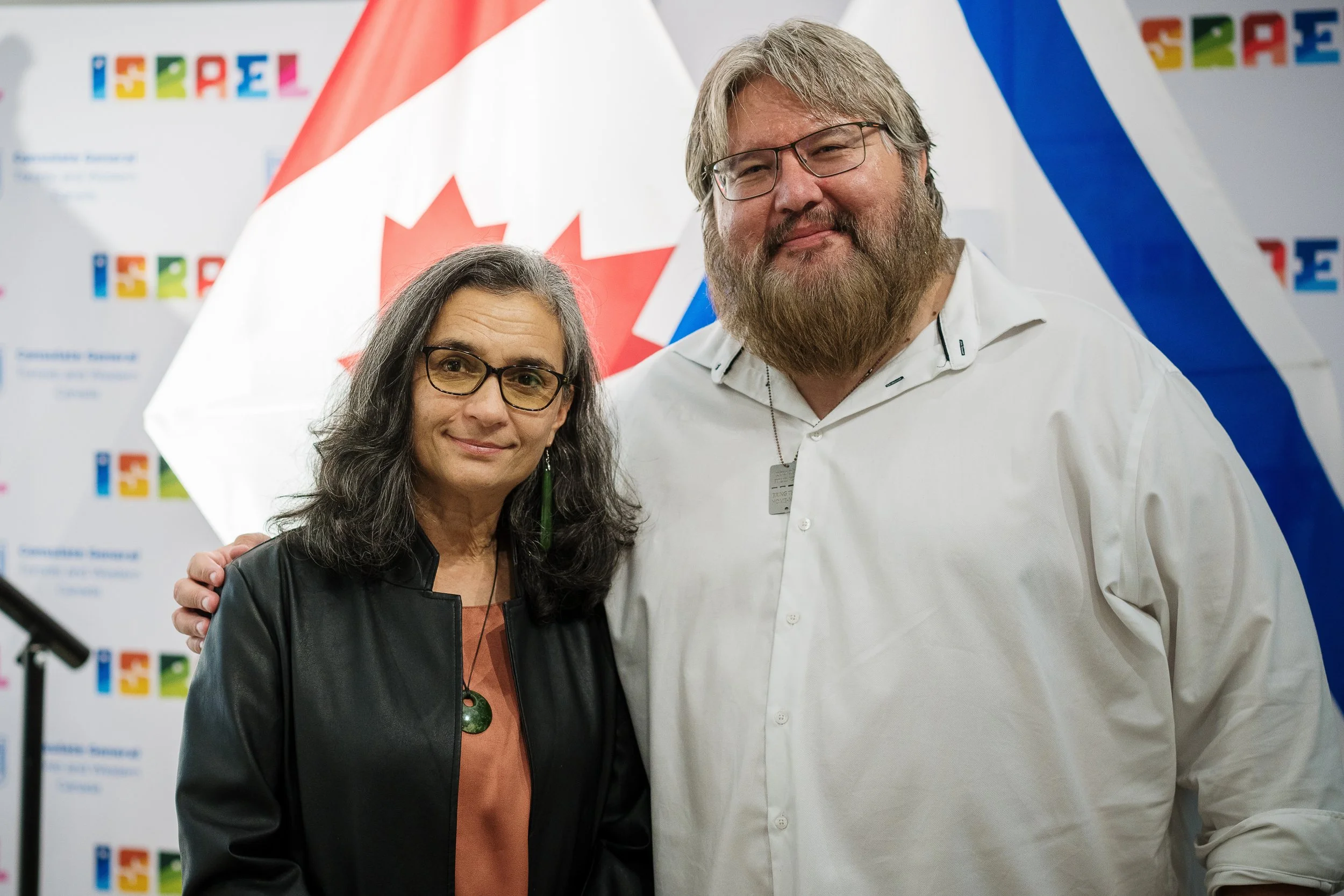
Dr Sheree Trotter with Ryan Bellerose, Métis.
Over the past decade there has been a growing recognition of Jewish Indigeneity. Some of the biggest advocates have been Indigenous Individuals. In 2017 Ryan Bellerose, a Métis from the Paddle Prairie Metis settlement in Alberta, Canada wrote,
“It is my belief that strengthening Jewish identity is the optimum way to fight against the perpetuation of false narratives and lies. This can be achieved only through an indigenous decolonization of Jewish identity, which would urge Jews to see themselves through a Jewish lens and manifest the indigenous aspects of Jewish identity in a meaningful way.”
Using the criteria set forth by José Martínez Cobo for the UN, Bellerose, like many others, recognised that the Jewish people fulfilled most of these requirements.
He stated,
“At its simplest, indigenous status stems from the genesis of a culture, language, and traditions in conjunction with its connections to an ancestral land, most commonly derived from ties to pre-colonial peoples. Once a people have such a cultural, linguistic, and spiritual genesis as well as a coalescence as a people, they are generally acknowledged as an indigenous people”.
Indigenous people have had a role to play in helping Jewish people to understand their own Indigeneity. Jewish anthropologist Adam Louis-Klein lived for a few months among the Desana tribe in the Amazon. He has said that studying another Indigenous people’s understanding of themselves made him reconsider Jewish civilization from within rather than through external political categories.
Jewish author Ben Freeman wrote the first monograph on this topic in 2025: ‘Jews: An Indigenous People’.
Indigeneity speaks of emergence of a distinct people in a particular land from which a unique language and culture develops. For the Jewish people, that land is historically known as Israel and Judea. Jerusalem became the political and spiritual centre of Jewish life. It is the land where their ancestors lie buried. The connection to ancestors is an integral aspect of Indigeneity. The Hebrew Bible, later Jewish literature and an enormous body of religious practice are embedded in the geography, seasons, flora and agricultural cycles of that particular land.
Jewish identity therefore differs in an important respect from membership in a universal religion such as Christianity or Islam. Jews have historically understood themselves not simply as adherents of a faith but as Am Yisrael—the people or nation of Israel.
That identity survived the loss of sovereignty and the dispersal of much of the Jewish population. After the destruction of the Second Temple by Rome in 70 CE, and especially following subsequent Roman suppression of Jewish revolts, Jewish communities became increasingly dispersed across the Middle East, North Africa and Europe. Yet Jewish presence in the land itself never entirely disappeared. Communities survived at different times in Jerusalem, Hebron, Safed, Tiberias and elsewhere. More importantly, dispersion did not sever the cultural relationship between Jews and their ancestral homeland.
For nearly two millennia, Jewish communities thousands of kilometres apart continued to orient their religious and communal lives towards the same territory. Jews traditionally pray facing Jerusalem. Jerusalem is invoked at weddings. The destruction of the Temple is commemorated annually on Tisha B’Av. Passover and Yom Kippur conclude with the hope: “Next year in Jerusalem.”
This is an extraordinary example of cultural memory surviving displacement. The connection is also embedded in the Jewish calendar. Festivals developed around the agricultural seasons of the Land of Israel. Sukkot is associated with the harvest; Pesach with the beginning of the grain harvest; Shavuot with its culmination. The traditional prayers for rain correspond to the climatic cycle of Israel rather than the countries in which diaspora Jews might actually be living.
Even the symbolic vocabulary of Jewish culture is filled with the ecology of the ancestral land: olives, figs, dates, grapes and pomegranates; palms, myrtle and willow.
A Jewish family living for centuries in Poland, Morocco or Yemen could therefore inhabit one physical landscape while practising a culture whose sacred geography remained somewhere else.
Language provides another striking example. Hebrew ceased to be the everyday language of most Jews during antiquity, but it never disappeared. It remained the language of prayer, scripture, scholarship, law and communication between Jewish communities. Jews developed diaspora languages such as Yiddish, Ladino and Judeo-Arabic, but Hebrew remained a common cultural inheritance.
Its revival as a modern spoken language during the Zionist period is therefore better understood not as the invention of a new language but as the vernacular revival of an ancient Indigenous one. Few displaced peoples have recovered an ancestral language so successfully.
None of this means that Jewish identity can be reduced to genetics. Indigenous identities are not simply biological categories, and neither is Jewish identity. Jewish communities incorporated converts and developed distinctive cultures wherever they lived.
Nevertheless, historical, archaeological and genetic evidence broadly supports what Jewish collective memory has maintained for centuries: the major Jewish diaspora populations share substantial ancestry originating in the Levant.
Diaspora changed Jewish culture, but it did not erase its geographical origins.
This matters because Jews are sometimes described simply as Europeans who arrived in Palestine during the modern Zionist movement. That description captures part of the history of some Jewish migrants, but it obscures the longer history of the Jewish people.
Ashkenazi Jews lived for centuries in Europe, just as Sephardi Jews lived across the Mediterranean and Mizrahi Jews lived throughout the Middle East. But diaspora location is not necessarily the same thing as Indigenous origin. A people does not automatically cease to be Indigenous because it has been displaced from its ancestral territory.
Zionism consequently can be understood, from a Jewish-indigeneity perspective, as a movement of national return: a dispersed people seeking to restore collective life, political agency and cultural flourishing in its ancestral homeland.
The revival of Hebrew, the rebuilding of Jewish communities, the return to Jerusalem and the re-establishment of Jewish sovereignty can all be situated within that story.
The remarkable feature of Jewish history is that, after centuries of dispersion, the Jewish people never stopped remembering their ancestral home.
https://www.indigenousembassy.org/articles/jews-and-cherokees-indigenous-case-studies?rq=Cherokee