

Debunking the Khazar Theory
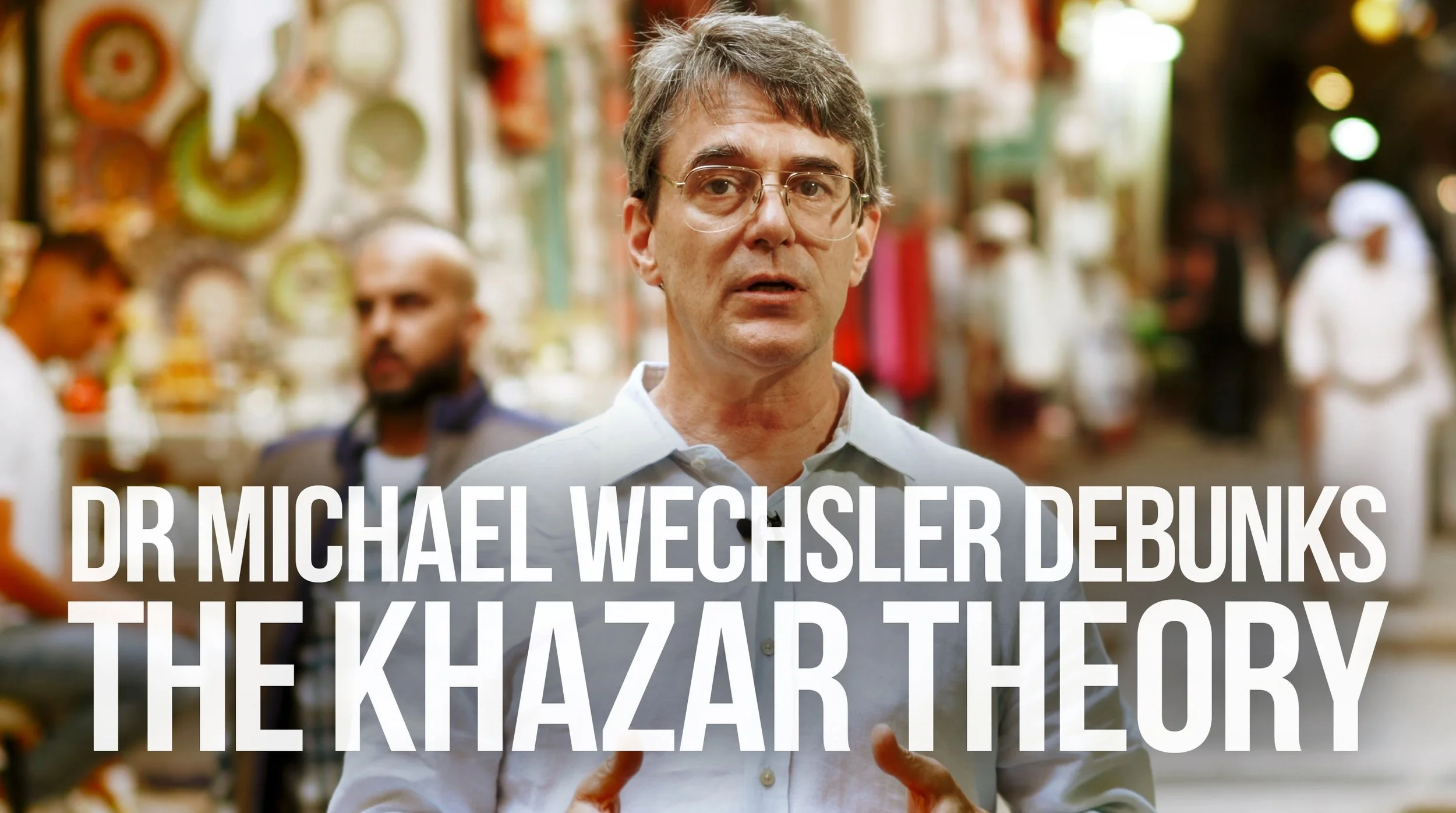
The Khazar theory is currently being advanced by Candace Owens, Tucker Carlson and others. Dr Michael G Wechsler is a linguist, historian and Bible scholar. He spoke at our 2025 Academic Symposium and, while in the Land, filmed this rebuttal of the Khazar theory in Jerusalem's Old City.
To summarize:
Some Palestinian writers argue that most Ashkenazi Jews are not originally from ancient Israel but are descended from the Khazars, a Turkic (Central Asian) people who supposedly converted to Judaism about 1,000 years ago. They use this claim to argue that Jewish ties to the Land of Israel are not genuine. Dr Michael Wechsler argues that this theory has been widely rejected by historians, archaeologists, linguists, and geneticists.
Key Reasons the Khazar Theory Is Rejected
1. The historical sources are weak
• Only a few old documents mention the Khazars converting to Judaism.
• The main Hebrew documents contradict each other and are considered unreliable.
• The few contemporary Muslim sources that mention it admittedly rely on rumor and hearsay.
• Many more respected Muslim historians from that time, when describing the culture and beliefs of the Khazars, do not refer to any of them having converted to Judaism or being Jewish at all.
2. Silence from other important sources
• Major Muslim, Jewish, Christian, Byzantine, and Russian writers from that era do not mention a Jewish Khazar state.
• Jewish religious leaders of the time, including those of the closest large Jewish communities, never refer to a powerful Jewish kingdom in Khazaria.
• Archaeology has found no solid material evidence of a Jewish Khazar empire.
3. Language evidence does not support it
• Ashkenazi Jews traditionally spoke Yiddish. • Yiddish is mainly Germanic in structure and vocabulary.
• There are no clear Turkic or Central Asian language influences in Yiddish.
• This supports the accepted view that Ashkenazi Jews are descended from Jews who migrated to Central Europe from the Mediterranean Basin, not Central Asia.
4. Evidence of non-Jewish practices
• A major 10th-century Jewish scholar, Saadia Gaon, described Khazars worshipping their ruler as divine.
• That practice contradicts core Jewish belief.
• This suggests they were not practicing Judaism in the way the theory claims.
5. Genetic research does not support it
• A 2012 study claiming a Khazar genetic link was widely criticized for flawed methods.
• Larger and better genetic studies show Ashkenazi Jews are genetically closest to other Jewish groups (Mizrahi and Sephardi).
• There is no strong genetic evidence linking Ashkenazi Jews to peoples north of the Caucasus (where the Khazars lived).
6. Jews were already in Europe before the Khazars fell
• Jewish communities existed in France and Germany centuries before the Khazar empire collapsed.
• This weakens the idea that Ashkenazi Jews mainly came from Khazars migrating west.
Additional Point:
Even if some Khazars had converted and joined Jewish communities, Judaism has always allowed conversion. So even partial ancestry would not cancel Jewish identity, let alone the collective Jewish claim of indigeneity to the Land of Israel.
Other Claims Mentioned:
The text also says some Palestinian leaders, including Mahmoud Abbas, have at times claimed that Palestinians descend from ancient peoples like the Philistines, Canaanites, or even the ancient Israelites.
Dr Wechsler argues these claims conflict with:
• Traditional Arab genealogies (which trace descent to Ishmael),
• And common Palestinian surnames that reflect origins in Egypt, Syria, Jordan, Lebanon, Iraq, and the Arabian Peninsula.
Overall Conclusion
• The “Khazar Theory” has been rejected by modern scholarship.
• It lacks strong historical, linguistic, archaeological, and genetic evidence.
• It is used politically to challenge Jewish historical connection to the Land of Israel.
• Even if partial Khazar ancestry existed, it would not invalidate Jewish identity or indigeneity.