
This is the first of a two-part series by Jonah Cohen, to mark National Native American Heritage Month. Jewish Statehood and American Tribal Law was first published by Tablet Magazine.
Israel is best understood not as an apartheid state, but as a protected tribal reserve
The United States pursued a one-state solution to the American-Indian conflict between 1887 and 1934. Treaty promises were ignored. Tribal governments were dismissed. Territorial boundaries were erased. Native peoples were no longer classified as members of foreign nations and instead were allotted land to build private farms and ranches. Many of their children were placed in federal boarding schools where they were taught to assimilate into the culture of the newly unified nation. Known by historians as the Allotment Era in U.S.-Native American relations, these assimilationist policies were championed in part by idealistic reformers who believed that Indian poverty would be alleviated when Native peoples abandoned tribal ways for the universalist principles of American citizenship. Their intention was good; their one-state experiment, a tragedy.
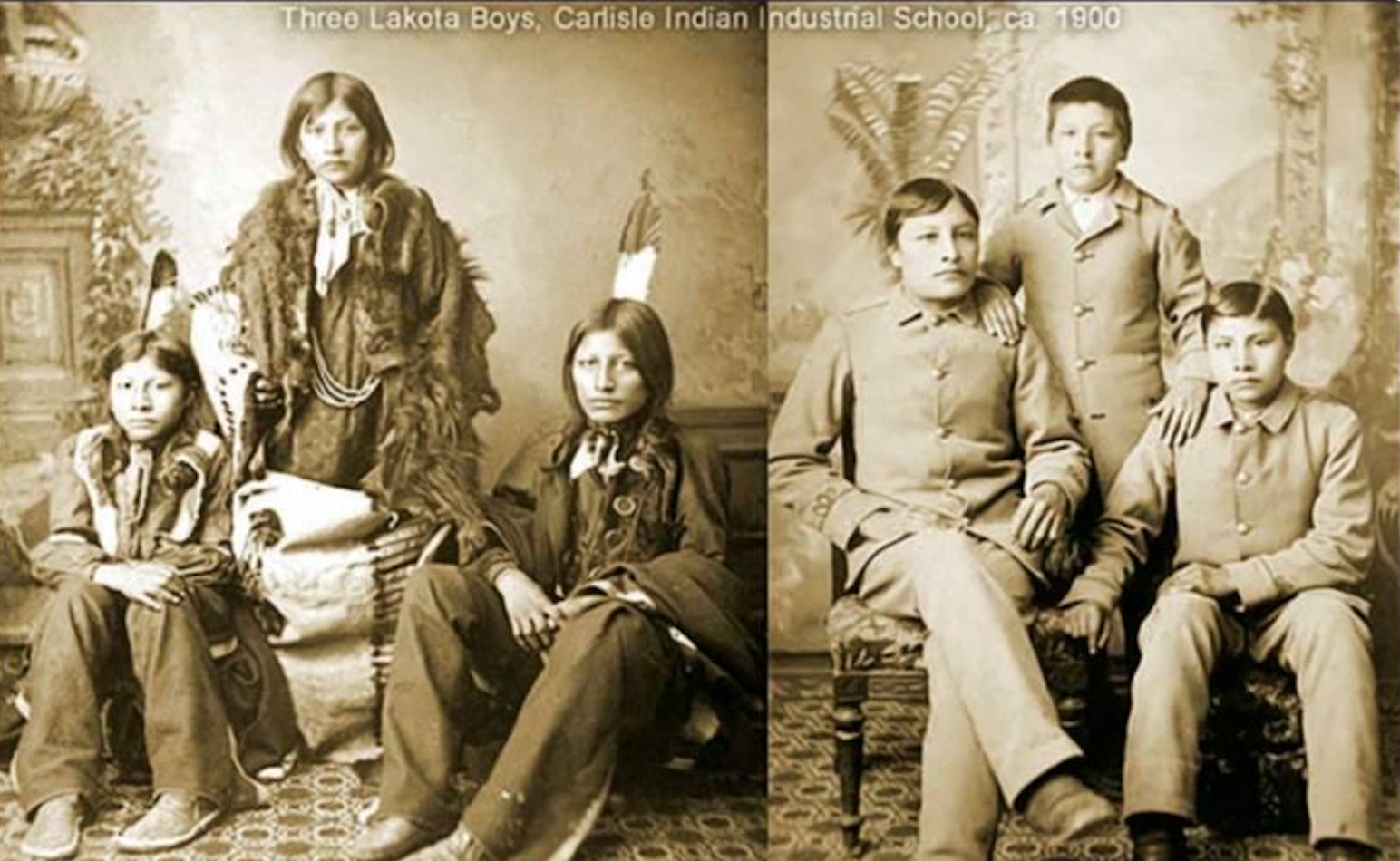
Before and after photos of Native American Children, three Lakota Boys, Carlisle Indian Industrial School, ca 1900.
Source: Teaching American Indian History with Primary Sources, Dan Eshet, Salem State University, 2020.
The project of “civilizing” Native children in boarding schools became notoriously abusive. Many allotted lands proved unfit for small-scale agriculture, while others required costly equipment most families could not afford. Thousands of impoverished Indians were left with no choice but to sell their property or lose it through foreclosure. Tribal landholdings plummeted from nearly 138 million acres in 1887 to 48 million acres by the time the allotment policy was repealed in 1934. It was a loss whose “devastation and trauma to tribal communities … cannot be overstated,” to quote the textbook Mastering Native American Law.
It was into this climate of anti-tribal reform, now largely forgotten, that Theodor Herzl’s The Jewish State first entered the public debate in the United States. Various reform rabbis and Jewish intellectuals, who had absorbed the anti-tribal zeitgeist, opposed Herzl’s “tribal” assumptions. Prominent among them was the distinguished philosopher Morris Raphael Cohen, who in 1919 published an influential essay in The New Republic titled “Zionism: Tribalism or Liberalism?”
Cohen argued that Zionism and Americanism are irreconcilable. “A national Jewish Palestine must necessarily mean a state founded on a peculiar religion, a tribal religion, and a mystic belief in a peculiar soil,” he wrote, “whereas liberal America has traditionally stood for separation of Church and State, the free mixing of races, and the fact that men can change their habitation and language and still advance the process of civilization.” When Cohen reissued the essay in his 1945 book The Faith of a Liberal, he likened Zionism to Nazi Aryanism, declaring that “tribalism is a creed that leads to grief and massacre.”
Against Herzl, Cohen insisted that “the Jewish problem is one that must be settled in each country separately” through assimilation and individual freedom. He maintained that as the world’s nations became ever more liberal, antisemitism would wither away. Though global Jewry’s faith in such promises mostly evaporated after the traumas of the Holocaust and the mass expulsion of Jews from Arab countries, Cohen’s portrayal of Zionism as inherently illiberal and backward nevertheless reverberated down the decades, giving birth in our time to a school of anti-Israel thinkers whom this paper calls anti-tribalists.
Anti-tribalists have published some version of Morris Cohen’s thesis in nearly every year of the present century. In 2003, historian Tony Judt’s much-discussed article “Israel: The Alternative” described the Jewish state as an “anachronism” in a world that had moved beyond tribalism toward open borders and internationalism. Four years later, Palestinian American activist Ali Abunimah’s book One Country characterized Israel as a “chauvinistic appeal to ethnic tribalism that stands no chance in a contest against democratic and universalist principles.” In 2009, historian Lawrence Davidson argued that Jewish Israelis must be “de-tribalized” before they can become truly “civilized.” The following year, author Gilad Atzmon suggested that “hatred towards any form of Jewish politics” is simply “a reaction towards a tribal, chauvinist and supremacist ideology.” A year later, political scientist John Mearsheimer touted the idea of “panicked Jewish leaders” who use “Zionism (blind loyalty to Israel) and scaremongering (the threat of another Holocaust) to keep the tribe united and distinct from the surrounding goyim.” In 2012, journalist Peter Beinart’s The Crisis of Zionism portrayed an American Jewish establishment that had forsaken its universalist ideals: “Liberalism was out; tribalism was in.” The result, he argued, was a kind of moral “schizophrenia” among Jewish leaders who rarely entered a synagogue yet still felt an “intense tribal bond” to the Jewish state. A few years after that, journalist Jonathan Cook denounced Israel’s “tribalist doctrine” as an “ugly, self-serving tribal reading of history.” Then came Pulitzer Prize-winning novelist Michael Chabon’s 2018 commencement address at Hebrew Union College in which he told rabbinical graduates to stop being such “boundary mavens” and instead learn to see “nations and borders as antiquated canards.” In 2024, The Harvard Crimson editor Violet Barron argued in her article “The Year I Left Israel Behind” that “Jews don’t need a state of and for Jews.” The same theme appeared in the film Israelism, in which campus activist Simone Zimmerman narrated a story of young American Jews being indoctrinated by “a Jewish establishment that is racist, that is nationalistic.” Behind all these statements looms the specter of Morris Raphael Cohen.
Those who invoke American values against Israel’s tribal character have misread their own country.
What distinguishes followers of this Cohenian tradition from other anti-Israel critics is not so much that Jews are alien implants on Arab land; some of them are willing to grant the antiquity of the Jewish presence in Israel and its historical centrality to Jewish faith and imagination. Rather, they insist that the tribal loyalty animating Zionism contradicts the cosmopolitan values of modern liberal life. As journalist Krystal Ball put it on her popular online show, it is not possible to “square the circle of being a progressive who supports equality here [in the United States] but also supports this ethno-supremacist state of Israel.” If democracy cannot be saved in a Jewish state, the implication runs, Jewish American liberals can at least salvage their moral consistency by severing their bond to this illiberal polity in the Middle East.
As in the Allotment Era, the words tribe and tribalism function in this intellectual tradition as terms of contempt rather than neutral descriptors. When filmmaker Eli Steele—whose ethnic background includes Black, Jewish, and Native American ancestry—publicly defended Israel after Oct. 7, he wondered why his critics responded by labeling him tribal. “How is supporting Israel tribalism?” he asked on social media. The insinuation was that his views required no rebuttal, that they were not really views at all, but the reflexive solidarity of a Jew too narrow-minded to think and feel outside his tribe.
That kind of dismissal is a characteristic move in this school of thought, but it would be a straw man to dismiss Cohen’s descendants as mere name-callers. Beneath their rhetoric of primitivism lies a recurring argument—the apartheid dilemma. Its logic basically runs as follows:
After decades of failed attempts to reach a two-state solution, Jewish Israelis stand before an impossible moral crossroads. They can either (a) maintain a legal system that prioritizes Jewish interests over those of Palestinians, or (b) establish a single state from the Jordan River to the Mediterranean Sea, with equal voting and immigration rights for all. Choosing (a) cements Israel as an apartheid state. But choosing (b) ends the Zionist dream of a sovereign Jewish homeland, since the larger Arab-Muslim population will gain political supremacy through immigration and higher birthrates, as occurred across most of the Middle East and North Africa.
This dilemma is formidable because it echoes a philosophical tradition with deep roots in Western thought. In her 1994 essay “Patriotism and Cosmopolitanism,” classics scholar Martha Nussbaum gave eloquent expression to that tradition. She argued that “national boundaries” are “an accident of history” with “a false air of moral weight and glory.” Our primary allegiance, she wrote, “should be to the community of human beings across the entire world.” Once that premise is accepted, the apartheid dilemma follows naturally. A state organized around preserving the political boundaries of a particular people or tribe loses its moral foundation. Israel, as one such state, becomes indefensible in principle.
“The main problem that Israel’s defenders face is that it is impossible to defend apartheid, because it is antithetical to core Western values,” Mearsheimer sums up this point of view. “How does one make a moral case for apartheid, especially in the United States, where democracy is venerated and segregation and racism are routinely condemned?” For that reason, he finds it “hard to imagine the United States having a special relationship with an apartheid state. Indeed, it is hard to imagine the United States having much sympathy for one.” He predicts that Israel will “eventually evolve into a democratic binational state whose politics will be dominated by the more numerous Palestinians.” His conclusion pulls no punches: “Israel is doomed.”
Much of the criticism directed at Israel’s Jewish character rests on the wider belief that tribalism is incompatible with American values. Ironically, the person who would do the most to disrupt that assumption was none other than Morris Cohen’s own son Felix Solomon Cohen. Prevented by his anti-tribalist father from having a bar mitzvah, the rebellious Felix grew up to become the principal legal architect of the Indian Reorganization Act of 1934, the groundbreaking legislation that reversed the policies of his father’s era and restored tribal self-government. That legislation helped pave the way to our own period, known as the Self-Determination Era, in which the United States formally recognizes the right of hundreds of Native nations to govern themselves across what is officially called Indian Country. The U.S. Bureau of Indian Affairs describes these lands as “permanent tribal homelands.”
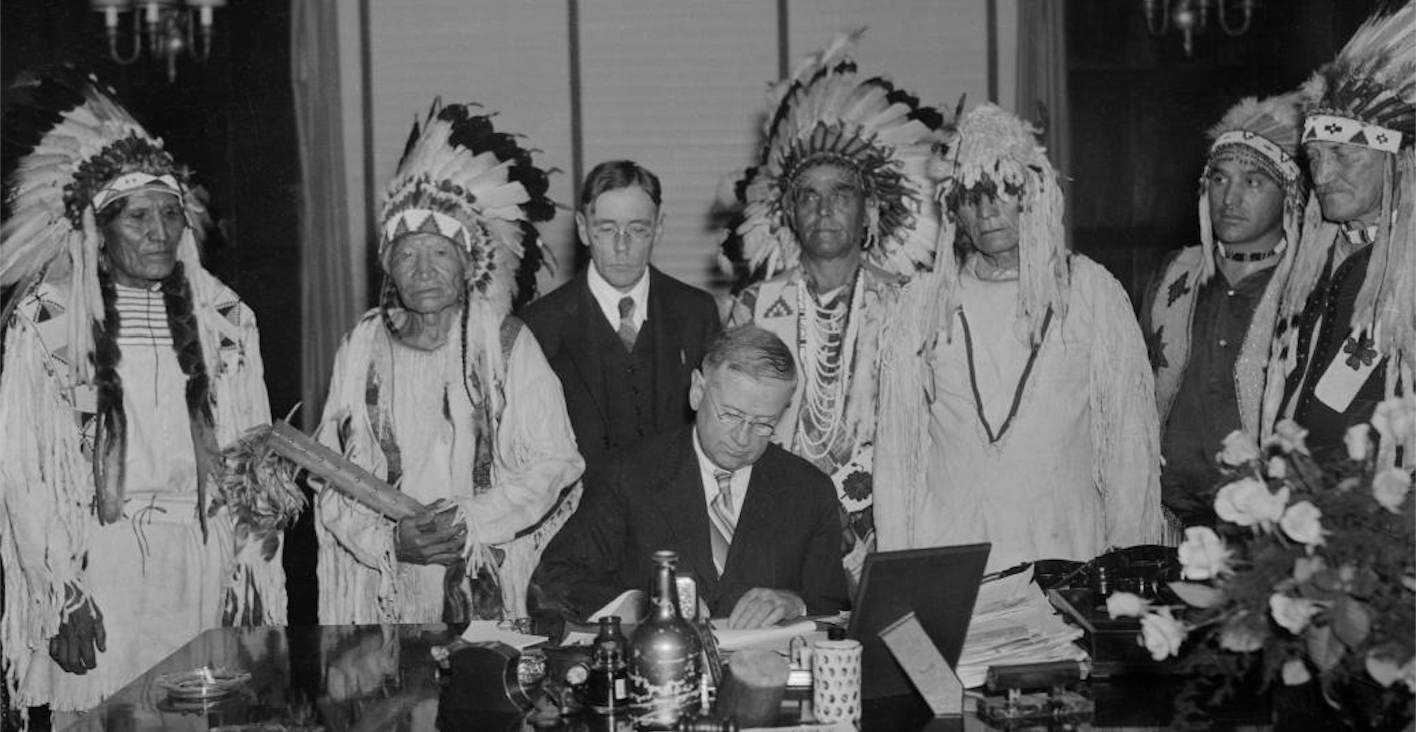
The Confederated Salish and Kootenai Tribes of Montana traveled to Washington, D.C., in 1935 for approval of the first constitution under the Indian Reorganization Act of 1934. Photo from History.Com
Felix’s contribution extended well beyond the 1934 Act. He is credited with creating the modern field of federal-tribal jurisprudence through his magisterial Handbook of Federal Indian Law (1941), still widely considered the “bible” on the subject. Where the father fought against tribal boundaries, the son built the legal framework that protects them. So influential was Felix in the revival of tribal self-rule that a biographer wrote a whole book “to figure out how a Jewish guy from New York became the guru of federal Indian law.”
What Felix’s study of federal law and Indian treaties revealed was that the American constitutional order rests not on two legal systems, but on three. Alongside federal and state law runs tribal law. It is enshrined in the U.S. Constitution, rooted in the inherent sovereignty of Indian nations—a status long recognized by the U.S. Supreme Court—and given practical expression through federally backed tribal constitutions. From those foundations, “Congress has passed so many laws applicable only to Indians that it has created a separate volume of the U.S. Code—Title 25—in which to place them,” notes legal scholar Stephen L. Pevar in his book The Rights of Indians and Tribes. By omitting this vast body of tribal law from their story of American values, anti-tribalists have misrepresented the nature of the United States.
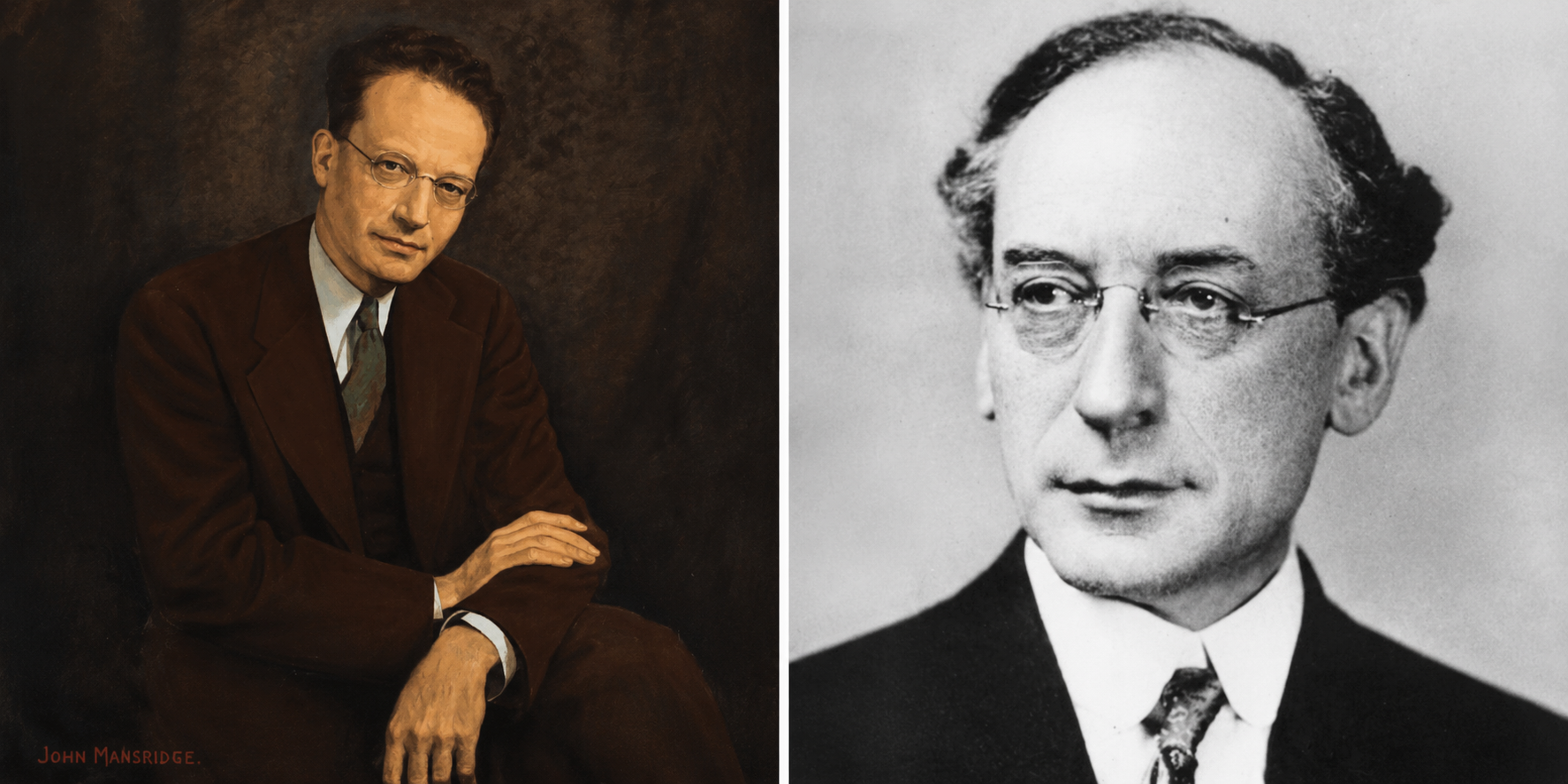
LH Feliz Cohen: Father of Federal Indian Law, Source: US Department of the Interior
RH Morris Raphael Cohen, Source: Wikimedia Commons.
Their misrepresentation goes unnoticed in part because many people wrongly assume that Indian Country is just another ethnic enclave within America’s multicultural democracy—like, say, San Francisco’s Chinatown or Boston’s Little Italy. In fact, entering a reservation means stepping into a separate jurisdiction with its own laws and authorities. Tribal governments determine citizenship, maintain courts and police departments, regulate economic activity, levy taxes, and exclude nonmembers from tribal lands. Indian Country is a form of sovereignty, not a neighborhood. Historian N. Bruce Duthu, in American Indians and the Law, observes that members of Native nations tend to regard their homelands as a basis on which “to return to a more respectful course of bilateralism” with the United States, “in which relations between differing cultures are negotiated through arm’s length and principled agreements.” Like many European nations that share a common currency and rely on NATO for much of their collective defense, Indian nations have entered into economic and political arrangements with their larger neighbors while pursuing their rights and interests through a shared judicial system.
The size of Indian Country is equally misunderstood. Tribal nations occupy or control over 56 million acres. To give a sense of scale, the Navajo Nation Reservation alone is more than three times the size of the state of Israel. In Arizona, home to more than 20 tribes, reservations cover more than one-third of the landmass. More than 40% of Oklahoma lies within Indian Country. In New Mexico, 11% of the state consists of Indian Pueblos. Indian Country, though smaller than it was before the Allotment Era, covers a vast area—larger than Israel by a considerable margin.
Its legal footprint is no less remarkable. One finds striking examples of America’s highest court siding with tribal governments over states, as in McGirt v. Oklahoma (2020), and against the U.S. government itself, as in Becerra v. San Carlos Apache Tribe (2024). The Supreme Court has at times even placed tribal interests above the individual. In Mississippi Band of Choctaw Indians v. Holyfield (1989), it invalidated an adoption of Indian children by non-Indians outside the tribal court system, explaining that the United States is “concerned not solely about the interests of [individual] Indian children and families, but also about the [collective] impact on the tribes themselves.” A similar concern for collective tribal rights appears in Morton v. Mancari (1974), which upheld a hiring policy favoring Indians over non-Indians for positions in the Bureau of Indian Affairs. The court maintained that the “Indian preference does not constitute invidious racial discrimination in violation of the Due Process Clause of the Fifth Amendment, but is reasonable and rationally designed to further Indian self-government.”
Anti-tribalists might reply that these legal rulings reflect the idiosyncrasies of judicial interpretation rather than any broader public consensus. But support for tribal self-determination extends well beyond the courts. A 2021 Ipsos poll found that 90% of Americans believe the U.S. government should honor its treaties with Indian nations. Nearly as many Americans (89%) support federally protected boundaries for sacred Native sites. Historian Suzan Shown Harjo explains that those treaties and boundaries secure the “sovereign prerogatives of self-identity, self-government, and self-determination” of Native tribes.
Support for tribal self-determination, although often associated with the American left, spans the political spectrum. It was a Republican president, Richard Nixon, who ushered in the Self-Determination Era in his landmark 1970 message to Congress calling on Americans to “assure the Indian that he can assume control of his own life without being separated involuntarily from the tribal group.” Republican President Ronald Reagan likewise championed Indian self-determination, and the Trump-appointed Justice Neil Gorsuch is often regarded as the most pro-Indian member of the Supreme Court.
Not all Americans, of course, care to honor those treaties and boundaries. In a 2024 monologue for the online conservative channel The Daily Wire, podcaster Matt Walsh cited the history of brutal Indian warfare and socio-economic challenges on some reservations as evidence for his thesis that “losers of wars” should not “get to keep land that they couldn’t successfully defend.” He concluded, “The whole Indian reservation thing is absurd. Like, can we just be—can we be done with this?” Such opinions, however, are not widespread among contemporary Americans, a fact tacitly admitted by Walsh when he complained that people feel “ashamed” to say what he said.
The constitutional provisions, the legal precedents, the polling data, the records of bipartisan support for Indian sovereignty—all point to one conclusion. Tribalism is not at odds with America and its values. It is embedded in the nation’s constitutional order and endorsed by its public conscience. Those who invoke American values against Israel’s tribal character have misread their own country. Calling Israel’s Jewish defenders tribal, however contemptuously, is not sufficient to render their position intrinsically anti-American. Nor does it establish that tribalism is necessarily at odds with liberalism, another thesis of the anti-tribalist school of thought.
Imagine a parallel universe in which John Mearsheimer has written a book called The Indian Lobby, denouncing Indian Country and excoriating the National Congress of American Indians and other “very powerful” Indian advocacy groups. “The main problem facing defenders of Indian Country is that it is impossible to defend apartheid, because it is antithetical to core Western values,” Mearsheimer would lecture students in packed university auditoriums. “Like racist South Africa, Indian Country is doomed.” Peter Beinart would further explain in The New York Times, “Native sovereignty in Indian Country and the idea of a democratic state is a contradiction.” All the while, politicians, podcasters, and campus activists regularly fulminate against Indian “dual loyalty,” Indian “privilege,” Indian “supremacism.”
In this other universe, these ways of speaking soon become prevailing political attitudes in the United States. Tribal governments, with their blood citizenship requirements, are condemned as “racist” in Congress. Federal and state laws are passed against “Indian apartheid.” Reservation borders are wiped off the map. Any American, as well as all future immigrants from across the globe, can now move freely into these once-tribal homelands; and, in time, they do so in great numbers, eventually erasing Indian Country altogether.
Tribalism is not at odds with America and its values. It is embedded in the nation’s constitutional order and endorsed by its public conscience.
What distinguishes this imaginary America from our own is that it treats individual equality as though it were the whole of liberalism. Any law that privileges Native communities over other Americans is felt to be racist and unfair. But liberalism, in our world, is not reducible to a single value. The liberal philosopher Isaiah Berlin, in his 1955 essay “Equality,” observed that even “the most passionate egalitarians” recognize circumstances in which the pursuit of equality must yield to other values: “the desire for happiness or pleasure, or for justice or virtue, or color and variety in a society for their own sake, or for liberty of choice as an end in itself, or for the fuller development of all human faculties.” Only the most fanatical egalitarian, Berlin wrote, will insist on individual equality as the supreme value in all situations.
Consider a small example. In Santa Fe, New Mexico, there is a historic public square called the Plaza. In one part of it, Native American artisans have for generations sold jewelry, pottery, and other handmade works, drawing visitors from around the world who come to admire and purchase authentic Native art. Under New Mexico law, that space is reserved for Indian artists selling their own work. A strict egalitarian might object that non-Indians are excluded. Yet few people, if any, complain that this legal arrangement is unjust or racist. The reason is that other liberal values besides equality are at stake: cultural preservation, protection against exploitation, concern for minority employment, the public’s aesthetic desire for genuine Indian artwork—what Berlin called the “color and variety” of society. Liberalism, in our world, makes such moral trade-offs.
Another example: In McGirt v. Oklahoma (2020), the Supreme Court recognized that nearly half of eastern Oklahoma remained under tribal jurisdiction, honoring 19th-century treaty agreements over the fierce objections of state authorities. Justice Gorsuch captured the impetus behind the decision in a memorable sentence: “On the far end of the Trail of Tears was a promise.” That promise—made to some 7% of the population—took precedence over the far more numerous non-Indian citizens of Oklahoma. The ruling illustrated Berlin’s philosophical point: Keeping promises is a value too, and under certain conditions it can outweigh even the foundational liberal formula that “every man to count for one and no one to count for more than one.”
“In its extreme form, egalitarianism requires the minimization of all differences between men, the obliteration of the maximum number of distinctions, the greatest possible degree of assimilation and uniformity to a single pattern,” Berlin concluded. “If this ideal is on the whole rejected in actual political doctrines, this seems mainly due to the fact that it conflicts with other ideals with which it cannot be wholly reconciled.”
Martha Nussbaum, who had done so much to popularize modern cosmopolitanism, eventually reached a similar conclusion. In a follow-up essay titled “Toward a Globally Sensitive Patriotism” (2008), she wrote that she no longer endorsed cosmopolitanism “as a correct comprehensive doctrine.” Duties to humanity, she maintained, must be balanced with attachments to “the particular people and places whom we love.” She came to see that the denial of particular attachments leaves life “empty of meaning for most of us” and that their “total uprooting” is “destructive of the human personality.” To dissolve them in the name of equality or any other universalist ideal would destroy something that liberalism, at its most thoughtful, has come to recognize as worth preserving.
Preserving those attachments across generations often requires laws and territorial boundaries. The need for such protections arises from a danger John Stuart Mill identified in On Liberty. Equality between individuals sometimes produces patent inequalities between a minority group and the majority that surrounds it. Smaller communities can become vulnerable to cruelty and erasure, as happened during the Allotment Era. Mill called this danger the “tyranny of the majority.” Awareness of it separates a mature liberalism from a naive one.
Tribal sovereignty, understood in this light, can therefore arise from liberal values rather than conflict with them. Those who invoke equality against tribalism would do well to recall Berlin’s warning that “many policies and views of life, themselves not particularly wedded to the ideal of equality, have been surreptitiously smuggled in under its cover, sometimes with a certain measure of disingenuousness or hypocrisy.”
Anti-tribalists are nevertheless correct that some forms of tribalism are incompatible with liberalism and contemporary American values. The Jim Crow South, Nazi Germany, and apartheid South Africa are paradigmatic cases of such polities. But it is a logical error to move from these poisoned apples to the conclusion that the entire orchard is rotten. The question is, what distinguishes the good fruit from the awful?
An answer to that question came from the bitter historical experience when American liberalism applied its universalist ideals without nuance to Native tribes and then spent decades trying to reverse the heartbreaking consequences. Out of that moral reckoning emerged a widely accepted principle: Under certain circumstances, a vulnerable tribe may justifiably maintain legal and territorial boundaries that preserve its existence as a distinct people. That idea, here termed the reservation principle, is commonly associated with six characteristics that frequently accompany legitimate tribal sovereignty.
(1) Historical Injustice and Suffering. The case for the reservation principle begins to take shape when a tribe can point to a historical record of maltreatment and misery at the hands of more powerful neighbors. Once that record exists, the burden of justification starts to fall on those who would deny tribal sovereignty rather than those who seek it. The broken treaties, the forced marches, the massacres, and the epidemics that devastated Indian communities lend moral weight to the case for applying the reservation principle to Native nations.
(2) Continued Vulnerability. The case becomes more urgent when a tribe is not merely historically wronged but also remains vulnerable to violence, discrimination, cultural extinction, or significant political marginalization. It is this kind of vulnerability that creates the need for legal instruments and territorial boundaries that safeguard tribal peoples and cultures.
(3) Minority Status. That vulnerability is compounded when the tribe already constitutes a small minority within a larger political or religious order. At roughly 3% of the U.S. population, Native Americans remain at risk of the tyranny of the majority. As the Allotment Era proved, erasing their territories would leave their communities outvoted and outbid at nearly every turn until they ultimately would be swallowed by larger groups. It is at this point that one begins to see why blind equality is not always sufficient for justice, and why legal structures that intentionally conserve a tribe may be necessary.
(4) Indigeneity. The case for the reservation principle strengthens further when that small and suffering tribe has a deep cultural connection to a particular land that predates other populations. For American Indians, the connection runs through their languages, ceremonies, and artistic traditions, many of them rooted in specific landscapes even when those lands have been lost or lie far away. Accordingly, indigeneity does not require unbroken physical presence or genetic homogeneity, since forced dispersion can disrupt both, as happened to tribes like the Muscogee after the Trail of Tears forced them into distant Oklahoma. What matters is the continuity of identity and collective memory connecting a people’s culture to a place of origin.
(5) Civil Rights Protections. The case becomes morally credible when the tribal polity governs in a way that respects the rights of all persons within its jurisdiction, not only its own tribal members. Following the Indian Civil Rights Act of 1968, tribal governments adopted protections analogous to those in the Bill of Rights. That political structure—a government oriented toward tribal survival yet also informed by concerns for civil rights—is crucial in making the reservation principle acceptable to the liberal mind.
(6) Cultural Enrichment. Finally, the case becomes even more compelling when the tribe’s continued existence contributes something irreplaceable to the broader civilization of which it forms a part—Berlin’s “color and variety” in society. Visitors who travel to the Santa Fe Plaza to admire Native art are expressing something more than aesthetic preference. They are recognizing that what the artisans represent cannot be replicated or substituted and that its disappearance would be a loss to the world. It is here that the reservation principle appears not merely as a response to historical grievance or a special form of ethnonational governance, but as an affirmation of things good and beautiful.
These characteristics do not function as a rigid checklist. Some tribal polities may exhibit certain characteristics more strongly than others. What matters is the overall pattern rather than any one essential feature. In this respect, the reservation principle resembles Ludwig Wittgenstein’s theory of family resemblance, in which differing things are recognized as a common group by an array of overlapping traits. When critics of Native sovereignty emphasize this or that tribe’s history of guerrilla warfare or socio-economic difficulties, as Walsh argued, the critique is a red herring. The relevant question is whether the tribe exhibits a sufficiently strong pattern of the six characteristics described above. When it does, its claim to the reservation principle becomes compelling. The Mescalero Apache illustrate the point. Entering their territory was once a terrifying proposition; today their homeland is among the most alluring and welcoming destinations in North America.
Judged against this family resemblance theory, the failures of Nazi Germany, apartheid South Africa, and the Jim Crow South become easier to understand. Nazi Germany could invoke the indigeneity characteristic, claiming a cultural and historical connection to ancestral lands, and for a time, much of the world accommodated that claim. But the Nazi regime failed miserably on civil rights protections and the cultural enrichment of its neighbors. Apartheid South Africa protected an ethnic minority, but that minority was not Indigenous, and it negated rather than upheld the civil liberties of others. The Jim Crow South likewise lacked civil rights protections, and crucially, neither the oppressors nor the oppressed were Indigenous to the land. In each case, too many characteristics are missing, or missing too badly, for the reservation principle to apply. That, ultimately, is what distinguishes the poisoned apples from the rest of the tribal orchard. Israel, as many observers have noted, clearly meets all six criteria laid out above.
The civil rights component of the reservation principle asks how Israel treats those under its jurisdiction, not how it responds to outside populations who regularly attack its citizens in a decades-long conflict.
In the end, there is an irony to the anti-tribalists’ critique. If they are correct that the Jewish state is not an ordinary nation-state but rather a tribal polity, that claim opens up a conceptual possibility that splits the horns of their own dilemma. Between “racist apartheid” and “cosmopolitan democracy” is the reservation principle, a third political category that, as we have seen, is compatible with both liberalism in general and American constitutionalism in particular. Among those who take up that option are Native voices who see in Israel the reservation principle at its most fully realized.
“When I look at what the Jewish people have done with their self-determination,” Jason Watson of the Chickasaw Nation told The Jerusalem Post, “it is something for all indigenous people to look up to and to honor and to say, ‘Look, this is what it could be, this is where self-determination could take us.’” That sentiment is widespread enough to have found institutional expression. The Indigenous Embassy in Jerusalem was established to affirm the affinity between tribal peoples around the world and the Jewish nation in its ancestral homeland. Chief Joseph Riverwind, a leader of the Arawak Taino Nation, explained the motivation behind the institution: “The story of the Jewish people, the indigenous people of Judea, brings us hope. For a tribal nation that has been able to return home, to their sacred sites, their culture, their tradition, their language.”
What these Native peoples see when they look at Israel is a polity that exhibits every characteristic expected of their own justified tribal homelands. A people with a documented history of persecution and suffering comparable to their own. A people that remains genuinely vulnerable, attacked in every decade of its existence, its communities harassed and threatened far beyond its borders. A people so numerically small that, as Mearsheimer himself observes, majority rule would mean being “dominated by the more numerous Palestinians”—who define themselves as part of a much broader and far more numerous Muslim Arab society that emerged from Arabia and conquered the entire Middle East. A people whose Indigenous connection to a particular land is confirmed by every record available: archaeological, documentary, cultural, genetic. A polity that extends full civil rights to all its citizens regardless of ethnicity or religion, consistently ranking among the happiest societies on earth. A civilization whose preservation has enriched the world in science, medicine, technology, literature, and philosophical thought. Israel, in their eyes, belongs in the basket of good tribal nations.
The significance of that judgment becomes clear in their rejection of the apartheid accusation. The non-Israeli citizenship status of Palestinians in Gaza and the West Bank, which anti-tribalists depict as evidence of Jewish apartheid and supremacism, fails to persuade these Indigenous advocates because the reservation principle distinguishes between a tribal polity’s own citizens and neighboring populations governed by separate political institutions. From that perspective, Palestinian political choices become relevant. Rejected statehood proposals notwithstanding, Gaza has been governed by Hamas since its violent seizure of power after the 2006 elections, while the West Bank has been run by the Palestinian Authority under powers it freely negotiated in the Oslo Accords. Throughout their autocratic governance, incitement and terrorism against Jewish neighbors have been the norm. The civil rights component of the reservation principle asks how Israel treats those under its jurisdiction, not how it responds to outside populations who regularly attack its citizens in a decades-long conflict.
That rejection of the apartheid charge connects to a deeper resentment among Native supporters of Israel. Born of their own history of conquest and Indigenous displacement, they find comparisons between Arab Palestinians and Native Americans not just inaccurate, but offensive. Santos Hawk’s Blood Suarez of the Apache Nation says his people were “highly offended when things came out in the media comparing Native Americans to Palestinians,” seeing the real similarities instead between Jews and Indians, two ancient peoples targeted for exile and extermination.
Likewise, Ryan Bellerose of the Métis Nation speaks in equally blunt terms: “While Arabs claim to be related to the descendants of Israel through blood, it’s just another way to say that they acted like all conquerors, raping and pillaging and then settling and subsuming the locals,” he writes in Tablet magazine. “Native North Americans especially understand that simply conquering indigenous people does not grant one indigenous status.”
Similar views were expressed at the Building Indigenous‑Jewish Friendship 2026 conference in Toronto, Canada. “The Islamist strategists correctly believe that their ideology-driven false narratives appropriating indigenous social justice language would resonate, and given traction with the academically ignorant and the academically sinister in Canada,” says Justice Harry S. LaForme, a member of the Anishibaabe Nation and the first Indigenous lawyer to be appointed to an appellate court in Canada.
More broadly, Native supporters of Israel worry that allegations of apartheid and Jewish supremacism carry implications far beyond the Middle East. As Indigenous rights activist Lani Anpo notes, the misuse of terminology about Jews and Israel poses a “dangerous precedent” for “Indigenous communities worldwide.” If tribal polities and laws are inherently illiberal and racist, as the anti-tribalists imply about Israel, that has destructive implications for the whole of Indian Country and its self-determination.
Behind these Native American applications of the reservation principle to the Jewish state stands a tradition of thought that reaches back to Felix Cohen. In the 1950s, as American one-staters once again sought to terminate tribal sovereignty, they routinely denounced Indian reservations as “ghettos.” Like the apartheid smear, the analogy recast assimilation as liberation and the destruction of tribal self-government as a humanitarian cause. Felix rejected the comparison outright. As his biographer recounts:
[Felix] Cohen, who rarely spoke publicly about Zionism, responded to the accusation that reservations are ghettos, which proponents of termination raised, by comparing reservations to the State of Israel. As he explained, while the term ghetto referred to “an area within which Jews were forcibly confined,” reservations and the State of Israel were homelands to their peoples, who had such a passionate attachment to them that they were willing to risk their lives to defend them. “Those who use the shibboleth of ‘emancipating the Indian from the ghetto’ as a moral justification for their efforts to pry Indians loose from their lands, timber, minerals, and fisheries,” Cohen noted with Jewish (and Indian) pride, “will be surprised, as were Arab armies, at the tenacity and effectiveness of Indian resistance.”(Dali Tsuk Mitchell, Architect of Justice, chap. 10)
Jonah Cohen is a research fellow at Indiana University’s Institute for the Study of Contemporary Antisemitism.